dimanche 25 juin 2017

City neighbors, country neighbors: worlds apart


Anyone who has grown up in a town like Pottsville knows that neighbors have a way of becoming part of one’s private life. Houses are close together, and even when they are not, the people next-door are never far away. In summer, we hear the lawnmower, the hedge-trimmer or the grind of a chainsaw; sometimes we hear the patter and pulse of a sprinkler or smell the smoke of a barbecue; on sunny days, we sniff the scent of honeysuckle or sweet william, wafting over a neighbor’s fence.

In the city, it’s different. In Paris, open windows in summer bring in the roar of traffic and only in the early hours of morning, before the first metro of the day, does city air offer respite from the heat. The sounds of summer are jackhammers and the drum brakes of city busses. The smells range from heavenly (in the warm evening air the scent of linden flowers greets commuters emerging from underground) to revolting (a lot of Parisian men, in imitation of man’s best friend, relieve themselves against trees or on the sidewalk, making the acrid stench of urine a typical Parisian smell).

As for people, they are everywhere. In city parks, like Buttes Chaumont next to my apartment, Parisians grapple for every available patch of green. On summer evenings, the lawns are a multi-colored patchwork of picnickers and apartment dwellers overwhelmed by the heat. Café terraces are packed; sidewalks are crowded. When temperatures climb above 90°, as they have this June, the city pours into the streets, seeking relief.


Yet, despite the crowds, we city dwellers remain unknown to all but a small circle of friends. Hemmed in on all sides, we ignore our neighbors, trying our best to block them out. We convince ourselves we don’t hear the flushing toilets, the surge of water pressure when a neighbor takes a shower, the thud of boots, the click of high heels, the shuffle of those too lazy or tired to lift their feet. Nor do we hear the voices; at least we do our best not to listen. Sometimes we can hear every word. When we do run into our neighbors, we nod our heads and say a quick “bonjour.”

On the whole—and this is what we need and crave in order to lead our private lives in a confined space—we prefer to remain anonymous.

In a small town like Pottsville, this is a challenge; in the tiny village where I live, population 1343, an impossibility. I know what I’m talking about. I have become a local specimen, a rare insect, pierced through the middle and pinned to a pinning block, on display.

Not much happens in my village. There is rarely the “pin-pon” of police cars or ambulances, the constant background noise of sirens Parisians live with night and day. Since I’ve been here, there hasn’t been a single fire and the crime rate is blessedly low, though juvenile delinquency is a problem, as is drunk-driving, the cause of some very serious accidents.


Daily events take place with clockwork regularity and they take place on the village square, the true theater of village life. Anyone who enters it to go to the bakery, the pharmacy, the superette, the village café or the post office, steps on stage, both actor and puppet, whose comings and goings belong to everyone.

Let’s say you usually purchase your daily bread at 9 AM. Then, one day, you change. You go to the bakery a couple of hours later, taking a risk because your favorite baguette, the seeded whole grain variety, may already be sold-out. In fact, it is and you are reduced to purchasing an “ordinary” baguette made with white flour.

The shy, sweet boulangère who sells you the loaf notices, as do other customers in the shop. When you step back outside, everyone is already wondering what event was so important that it made you break with routine.

No one (except you) will ever know and no one will ever ask. The pleasure is not in knowing, but in speculating about the myriad reasons that could have made you change. Before you know it (and perhaps you never will), you have a fatal disease, a secret lover, or a serious problem with drink.

As a foreigner, an American (Trump is not endearing us to the world), a Parisian, a woman living alone, when I cross the square, I am transformed into the perfect specimen, an actress in a series destined for a long run.

Already I have been suspected of a liaison with the husband of the owner of the superette. I like to talk to him, which is not a crime, but readers, I assure you, I never drew him to my bed. Browbeaten by his wife, these days he barely says hello, and when he does, it’s without a smile.

I am also a persecutor of the disabled, when in fact the disabled are persecuting me. My immediate neighbors are a couple about my age, the man, an ailing alcoholic; his companion, a woman whose mental problems guarantee her a disability pension and protection for life.

Soon after my arrival, I invited the woman to my home because she begged to see my new kitchen. Though warned by the owner of the local café to never let her in—once she crossed my threshold, she’d attempt to do it every day—I opened my front door and invited her inside. When finally, after too many visits, I stopped, she put her fist through my front window, her hand protected by a sheepskin glove.

I went to the police, I filed a complaint, I divided the village in two: the Montagues and the Capulets, the Hatfields and the McCoys, everyone has taken sides and the final battle has yet to be fought.

When it is, I’ll be ready because I learned the ins and outs of small-town life in my mother’s Pottsville home. From her redoubt, which was also her sunroom, she observed every move on her street through a slit in the venetian blinds. When something happened (a neighbor parked his car in a different spot, another forgot to put the garbage out), she was ready with an explanation meant to reestablish order on the block.

I’ll be ready too, because life has taught me that in small town or village, whether we like it or not, we can’t escape our neighbors, nor can they escape us.

dimanche 28 mai 2017

Cultivate our gardens: An antidote to politics?


France has a new president, the youngest in its history, with a wife 24 years older, exactly the age difference separating Donald and Melania. Four years younger than John F. Kennedy when he took office in 1961, Emmanuel Macron is creating feverish excitement in France and abroad.

All the world is talking about this new president and his young prime minister, Edouard Philippe, 46 years old and member of “les Républicains,” the party founded by former Right-wing president Nicolas Sarkozy. A balancing act has been set in motion for next month’s legislative elections. In choosing Philippe, Macron hopes to form a ruling majority with candidates from both Left and Right. This, he hopes, will enable him to push through his reforms.

As the end of May approaches, it is almost impossible to escape politics (and since last November’s US elections, Americans must be feeling the same—is there a day without a new scandal?). Online or off, on paper or on screens, in words and images, politics, politicians, their advisers and their families have become our daily bread—to excess.

The world is in a scary state and today it may be just as dangerous as when a young John Kennedy faced the Cuban missile crisis in 1962. I remember leaving for Jackson Street School in the morning, fearing nuclear attack and wondering if my family would still be alive at the end of the day. The city was dotted with “fallout shelters” and at school, we had drills where we would hurry into the cloakroom, stoop down and puts our hands on our heads, this apparently to protect us from nuclear bombs.


Sometimes, during these drills, the entire town of Pottsville shut down. Traffic came to a halt while sirens whined. Only when civil defense agents gave the go-ahead, could cars move about again.

Once waiting at an intersection with my father during such a drill, I asked him why we would be safer in shelters. He explained, very frankly, that they offered no protection, nor did the cloakroom at school. The only advantage, he said, was that we could all die together, if there was any comfort in that!

My father spent World War II in the US Army in the Philippines. He was on a boat off the coast of Japan when the first atomic bomb was dropped. A survivor, he’d become blasé about death and dying, unafraid to share his feelings—and harsh reality—with a child.

I love the month of May, its lush beauty, the succession of wonders from beginning to end, white and purple lilacs, pink magnolia, lilies of the valley, iris or blue flags, as my mother used to call them, though this year I’ve seen some that are pale yellow and copper-toned.


Yes, I love the month of May and as an antidote to politics, I’ve taken to cultivating my garden, following advice I found in the work of Voltaire, 18th century French philosopher and author of philosophical tales.

In Candide, the most famous tale named after the main character, this naïve young man travels around Europe and the world, encountering war, natural disaster, and the hardships of ocean voyage before he can finally settle down on a simple farm with his ladylove, her virginity lost to others, her beauty destroyed.

On that farm, Candide follows the advice of one of his companions of misfortune, who advises him to cultivate his garden and “stop thinking.” In that way only, he assures Candide, does life become bearable.

I don’t know if I’m ready to go that far, but my garden is a refuge from the troubles of the world. After a hard day at the computer, that’s where I head to squat and dig my hands into the soil. When I return from Paris, I enter the front door, drop my bag and head out the back, impatient to observe any change.


So far, my lettuce patch would be a delight to Peter Rabbit, and just this morning, I discovered the first shoots of the fava beans I planted about ten days ago. I also have a beautiful potato patch, though it has already known hard times. A late frost bit some of the early shoots, but I hoed and built up my potato mounds again.


There are also predators, grub worms eating the roots of my lettuce crop, one head going, another on its way. I am worried! I consult articles on line, determined to cultivate an organic garden, but I’m not sure how to combat these dangerous pests. If any reader has environmental-friendly suggestions, please write!

I’m also busy training the branches of my apple tree so they eventually grow horizontal to the earth. Last autumn I planted it against a wall and someday I hope its long sturdy branches, heavy with fruit, will stretch along it as they bask in the sun.

On May 14th, I planted tomatoes. I chose that date because my friends told me I had to wait until after “les saints de glace,” the ice saints Mamert, Pancrace and Servais, who, since the Middle Ages, have been associated with late springtime frosts. According to popular wisdom, tomatoes put in the earth before their feast days are unlikely to survive whereas gardeners who wait will have a bumper crop.

My garden keeps me busy, it gives me solace, it makes me realize how fortunate I am to be alive, able to dig, plant and weed for hours. I listen to the wind and the birds, finches, robins, chattering magpies and even cuckoos. This is the life, I say to myself, as I learn to submit to the elements, so independent, so indifferent to our obsession with performance and speed.

President Macron wants to act quickly. He wants to “reform” France, beginning with an overhaul of labor law, an issue that, in a recent past, sent citizens streaming into the streets to protest. He also wants to combat endemic unemployment, the biggest problem facing the country today.

Yet, I hope he will not change France too much because life remains good here and there is much to preserve and protect. As French travel journalist Sylvain Tesson writes, “France is a paradise whose inhabitants think they are in hell.”

I tend to agree and I’m going to try to take advantage of paradise while I can.

dimanche 30 avril 2017

French presidential elections: a half-hearted vote in uncertain times


Driving home at the end of election day, the first round in the 2017 French presidential elections, I noticed, flapping in the breeze, a hand-written note stuck beneath my windshield wiper. Was there a problem? Had someone put a dent in my car, parked since early morning on a public lot? Worse still, had I done something wrong?

I pulled over to the side of the road, got out and grabbed the note. Unfolding the paper, this is what I read: “Es-tu sûre, Nancy, d’avoir bien voté?” (Nancy, are you sure you made the right choice at the polls?) No signature, just a message, and though I had a hunch who wrote it, I read those words as if they had been beamed down by a ghostly oracle watching me from the sky.

Did I make the right choice, did I use my vote well? The morning after, I have to answer, I don’t know.

I voted. I made the effort to get up early on a Sunday morning and travel to Paris, where I am registered to vote. I crossed the city by metro to get to my polling place, an elementary school located a few steps from my Parisian apartment.

Voter registration card in hand, I crossed the threshold and immediately got in the wrong line, the one for those who had already been inside the ballot booth to cast their vote. I had forgotten to “pass go,” to stop at the table where volunteers check my name on a list and then invite me to pick up a small envelope and 11 rectangles of paper, each one stamped with the name and party of one of the 11 first-round presidential candidates.

Once I did that, I stepped into a voting booth, stuffed one paper in the envelope, and threw the other ten in a waste basket at my feet. Then I opened the envelope and peeped inside, afraid I had made a mistake. No. The “right one” was there. Closing the envelope again, I accidentally tore it. As I joined the line of those who had already voted, I tried to smooth it to make my vote look respectable.

When I arrived in front of the transparent ballot box, a woman checked my name in the ledger of those registered to vote and I signed. Then I dropped my envelope into the box and the official observer pronounced, “A voté” (she has voted).


It was over, my duty done. Eleven o’clock was chiming at a nearby church. I was free for the rest of the day. I headed to the outdoor market at Aligre Square, one of the best in Paris, where I met my dear friend Nathalie and we shopped for lunch. We also roamed through the flea market, and I bought a pair of cashmere and flannel trousers for a song.

By one that afternoon, too busy cooking and talking non-stop, we’d forgotten all about the elections. After eating, we sat on the floor and talked some more, warmed by the brilliant sun streaming into Nathalie’s top-floor apartment. Later we strolled along the Seine, joining a dense crowd, stopping to watch couples dance the tango on a platform near the water.

A lovely spring day that would have been perfect had it not been for the unshakeable doubts and anxiety lurking in the back of our minds.


Once back in le Perche, a region faithful readers are getting to know, first I found the note, then I returned home and turned on the TV. The names of the two front-runners were on the screen: 23.9% for Emmanuel Macron, representing the movement (and not the party) En Marche (which could be translated as “moving forward,” besides being the initials of the candidate’s name); 21.4% for Marine Le Pen, the candidate of “the people,” member of France’s far-right dynasty and president of the Front National, the party founded by her father Jean-Marie in 1972. On May 7th, voters will choose between the two—or for many, not vote at all.

But what about me? Up until this point, I’ve been tight-lipped about my half-hearted vote. Let’s just say I voted like a typical Parisian. Like 35% of the city’s voters, I chose Emmanuel Macron, a young man (age 39) who has never held an elected office and comes from the world of high finance, a neophyte to politics, a complete unknown three years ago, at the head of a movement he founded only a year ago. Macron came in first place in the city; Marine Le Pen did not even garner 5% of the vote.

This morning, first thing, I checked the results in my village. I was not so happy with what I discovered, but I was not surprised. Le Perche is a region that has traditionally voted socialist. In the 2012 presidential elections, François Hollande came in first place, but in five years things have changed. In the first round of the 2017 presidential elections, the far-right candidate Marine Le Pen is leader of the pack with almost 30% of the vote (out of 1503 votes in a commune composed of three small villages and adjacent hamlets).


The local papers have been saying it for weeks: when Marine Le Pen travels to this corner of rural France, she is entering friendly territory. Here people work hard and many are self-employed; unemployment is slightly below the 10% national average, but among young people, rises above 25%. Many are angry and feel forgotten by those who govern them. If only there were fewer foreigners, which—let’s say the words—means Arabs and Muslims, there would be more work, more opportunities, finally, more money for the “true” French.

And who am I to judge? I’ll admit, I do not share their fear or rejection of “foreigners.” After all, a majority of my students are of Arab or Muslim origins and for me, they represent the future of France. I better understand their fear of poverty and the feeling that things are getting worse. Though I constantly worry about money, I always manage to pay the bills, and compared to my country neighbors, I am one of the “haves” among many “have-nots.”

Finally, this is why I am not happy with my vote. I voted cautiously, choosing my interests over theirs, deliberately rejecting both far-left and far-right, yet still unsure to have made the right choice.

In a week, France will have a new president. As goes Nancy, so goes the nation? We’ll have to wait to find out.

dimanche 26 mars 2017

Auction fever (2)


The sale begins. The pros and the most avid bidders crowd around a big wooden table dragged out from the garage. This, along with the wooden chest where the auctioneer stands, is the auction block.

The rest of us line the stone walls separating the driveway from a raised garden. This gives us a bird’s eye view of the table and the auctioneer, a highly trained professional who often behaves like a carny. I’m standing on the edge and every once in the while an impatient bidder pushes forward, throwing me off balance, forcing me, if I hope to avoid a fall, to take a quick step backwards into the flower bed where well-tended rose bushes are taking their winter rest.

But this pushing and jostling is all part of the game, a game of combat. An auction is physical; literally, you must be on your toes, poised for action, eyes and ears open, arms stretched forward to grab your newly acquired possessions, passed from the auction table above the heads of the crowd once the auctioneer, with three strikes of his gavel, has proclaimed “Adjugé, vendu!” (going, going, gone).

It rains, the rain stops, a crisp west wind blows in clear skies. The sale is moving fast. Little by little, I begin to follow and understand, with regret—my feet are already numb, that the objects that interest me will not go on sale till afternoon.

For the moment, up for auction are a lifetime of knickknacks, paintings, statuettes, busts, a porcelain dinner service and many sets of everyday stoneware, copper pots and pans, several dozen wine carafes, carved African stools and masks, a collection of minerals and one of magnificent conch shells, a full collection of the acts of the historical society of le Perche, a few fine and ancient maps of the region, and some delicate 18th century lace, carefully mounted and framed.

I follow the proceedings, moving fast. Some items, such as the lace and a pre-revolutionary map of le Perche go for several hundred euros. Others, sold by lots piled in cardboard boxes, for twenty or thirty, and I begin to understand that those boxes are a lot like grab bags. Nobody, not even the auctioneer, knows exactly what you’re going to get: there may be a treasure hidden among the crockery and bibelots.

A woman standing next to me hits the jackpot. Rooting through her box of glass and stoneware, she pulls out two crystal wine carafes with the imprint of Cristal Saint-Louis, the oldest glassmakers in Europe. For thirty euros she walks away with the prize.

I watch her bid. She is experienced. She knows what she wants. She buys lot after lot, and her cardboard boxes, buckling beneath the weight of their charge, are passed to her and then piled up on the lawn behind us or at the foot of the wall where we stand.

When I ask her if she is in the antique business, she vehemently denies it, explaining she is buying for her children, for nieces and nephews, all setting themselves up in life.

I know she is lying; she must know I know, but this is not a world where you trust your neighbor. Everyone at the sale is a potential rival and she has no idea who I am. And who knows? I could be a secret agent from internal revenue sent to crackdown on antique dealers who, notoriously, hide much of their business from the taxman.

The young man standing on the other side of me is more forthcoming. He sells on line and is looking for objects from the first half of the 20th century. He buys an art deco vase, paying more than 200 euros, and a telephone from the 1930’s. He’ll post these items on his site and, I hope for him, make a profit.

There are other professionals bidding on what to my eye are atrocities, a horrible 16th century statue of Sainte Barbe, a Christian martyr who had her head and her breasts cut off, and an equally ugly signed 19th century terra cotta bust. Both go for close to 1,000 euros.

Then it is time for lunch. Because this is France and no one can imagine going without a hot meal, the doors of the maison bourgeoise are locked and the crowd disperses to cars or to the center of town. I head for the bistro where I had a coffee in the morning. Packed, all the tables reserved, but if I’d come back in about a half hour…


I explore the village of Longny-au-Perche, discover a 16th century church, Saint Martin, with a painted wooden nave. At the edge of town, I walk past a Renaissance chapel where each year, on September 8th, a pilgrimage takes place to venerate the Pieta inside. There are also many streams and old mills with mill wheels turning and half-timbered houses that look like they belong to Shakespeare’s time.


The village is sleepy, many storefronts are empty, but time passes quickly, despite the damp cold, and when I return to the restaurant, a little table is waiting for me.

And once again I have a bird’s eye view of the auctioneer. He and his employees dine together. He has removed his padded coat, and beneath it wears a mustard-colored hunting jacket that reminds me of a famous 1939 French film, Jean Renoir’s “Les règles du jeu” (The Rules of the Game), where aristocrats and the wealthy gather for a weekend of hunting in a country château. He could be a part of that world and several remarks he makes during the sale make me feel he regrets its passing.


While I observe, I warm up and eat an excellent salade de gésiers, a chicken gizzard salad with two vinaigrettes, one raspberry and the other mustard, both extremely fine. I drink a glass of red wine and, for you, dear readers, sample a dessert. I try the homemade lemon tart with freshly whipped cream, a “délice.”


But then it’s back to the cold. Clear skies have replaced the rain and the sun shines on me, bringing me a stroke of luck. Though most of the furniture will be auctioned off inside, the armchairs I want are already out on the auction block. I take out my number and I’m ready to bid.

Perhaps not everybody is back from lunch. Perhaps wooden armchairs are not a hot item. For a little more than 100 euros, I walk away with two beautiful cherry-wood chairs that, once I get them home, immediately find their place in my living room.


Now I’m ready for the next sale. I’m ready to swoop down on another man’s life and pick over the remains, acutely aware that someday my precious belongings will suffer the same fate.


dimanche 26 février 2017

Auction Fever (1)


Early one summer morning, a couple of years ago, I was walking along the railroad tracks off route 895 near the village of Molino. It was early, before 7 am, but the air was already warm and heavy with moisture. Mist rose off the Little Schuylkill and floated in wisps above a marsh where two blue herons were busy fishing. Looking around me, I was filled with a sense of the beauty and harmony of Nature.


Then I rounded the bend. Atop five or six utility poles sat a committee of vultures. On the ground, the skeleton of a deer, what had recently been its carcass, lay next to the tracks, picked dry to the bone.


The vultures followed me with their eyes, and as I advanced further down the tracks, they changed positions, spreading their wings, rising into the air and settling on the next pole, not letting me out of their sight.

They were waiting, for another train, for another strike. They were waiting for me to turn into a carcass. They were hungry and saw me as a potential next meal.

This month, in the dead of winter, I got to feel what it’s like to be a vulture. I went to my first public auction. I joined a “committee” and honed in on the prey.

I’m partly joking of course, but only in part. Above all, I’m not criticizing or making fun of others, because the “vulture spirit” swooped down and took hold of me.

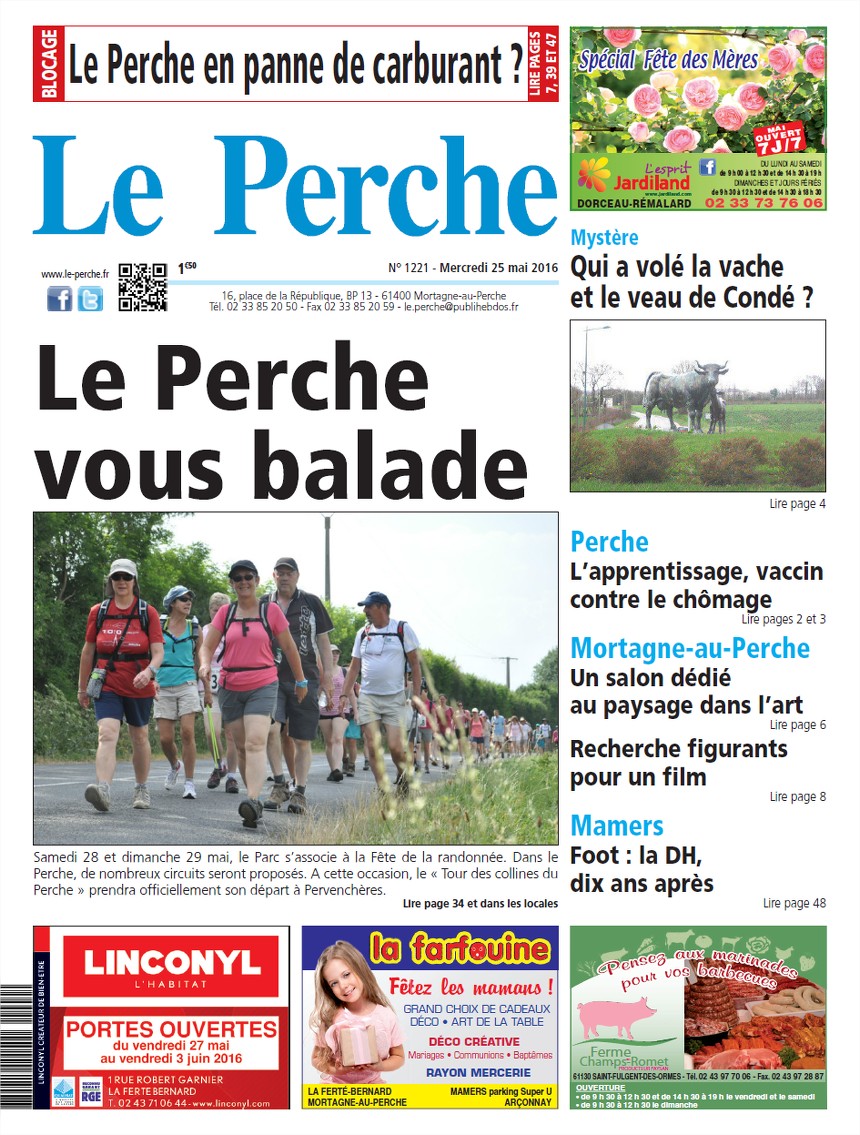
It all started with a newspaper, a weekly called Le Perche, the name of the region where I have my country home. I buy the paper faithfully every Wednesday, the day it appears, and read it on the train to Paris, paying special attention to the classified ads. For months, I’ve been on the lookout for a particular kind of auction, a sale of the contents of what the French call a maison bourgeoise, the home of a family belonging to the upper middle class.

About a week ago, eureka, I found one. I cut out the ad, visited the on-line site, and printed the photos of objects that interested me.

On the Saturday morning of the sale, under a dark sky, in pouring rain, I set out for the town of Longny-au-Perche, driving about twenty miles through hills and forests that reminded me a lot of Schuylkill County.


Once I arrived, I drove in circles looking for the site of the sale and only found it once I parked my car in the municipal parking lot and set out on foot. I had believed I was looking for an auction house. I ended up in front of the maison bourgeoise. All its contents and the house itself were up for sale.

We, the “committee,” tramped through the house, opening drawers and closets, trying out chairs, testing mattresses, rifling through boxes, elbowing anybody who got in our way. We handed over blank checks in exchange for a bidding number. Then we continued to comb through the contents of the house, waiting impatiently for the sale to begin.

A rich life had been lived there, rich in terms of experience and love. A happy couple had spent a long life together, some of it abroad, in Asia and Africa, at a time when France still had colonies in those parts of the world. The house was filled with their souvenirs.

And they had cherished their home and organized it with great care. I recognized a sense of order, not rigid or obsessive, but put in place so the inhabitants of that house could get on with the more important things in life. Monsieur played pool in the billiard room; Madame was an amateur pastry chef and had a veritable laboratory for baking in the basement of their home.

Then they got old. They moved from the master bedroom upstairs to a back bedroom off the kitchen, perhaps once meant for domestic help. They went from a double to single beds. Medical equipment filled the last room they shared. One died; then the other. Their grown and already aging children had no use for what they had lovingly accumulated throughout their long life together.

Sensing their story as I studied their things, I felt like one among a horde of intruders, soiling with our muddy boots and shoes a lifetime of intimacy.

But my scruples were superficial. I wanted to be there as much as the rest of them, the professionals from the antique barns that pop up regularly along the main roads in the region, a few Parisians with upscale antique shops, lots of young people selling their wares on line, the curious, those looking for a bargain, a crowd where most people seemed to know the rules.

Despite the rain and the cold, in a house with all the doors thrown open, the rooms were heating up. I had to wait my turn to go up and down the stairs and there was a line in front of certain rooms. The billiard table had a lot of success, as did a 19th century children’s bed, a cross between a cradle and a boat, perfect for Winkin, Blinkin and Nod “setting off in the night into a sea of dew.”

So many things awakening so much craving for what we did not yet have! But if we were wily bidders, not bidding too much but just enough to clinch the deal, we could leave at the end of the day, our craving satisfied.

I know what I want but have no idea how to get it. I’ve never bid at an auction before and hold tight to the number issued me in exchange for my signed blank check.

The agents of the auction house are entering the rooms, pushing us towards the doors, down the stairs, locking doors behind them, chasing us outside, into the rain and cold, where the sale will take place.

The auctioneer, called a commissaire-priseur in French, member of a tight-knit and exclusive corporation, is the only one who looks dressed for the occasion (I’m not, I thought the sale would be inside and once it’s underway, I’m shaking like a leaf). He’s wearing a handsome flat cap made of Harris Tweed, a padded-jacket to keep out cold and rain, wide wale corduroy trousers, and thick-soled black boots.


Standing on a wooden chest, gavel in hand, he is about to set the sale in motion (to be continued March 26th).

dimanche 29 janvier 2017

Touching the Past


In the year 1587, 430 years ago, France was torn and bleeding. For more than a quarter century, religious wars pitting Catholics against Protestants, involving torture, famine, massacres, assassinations and calls to regicide, had been the cause of near 3 million deaths.

In the same year, across the English Channel, Queen Elizabeth I signed the death sentence of her cousin Mary Stuart, fervent Catholic and the once Queen of France, married to King François II, who died in 1560 after having reigned for only two years. On February 2, 1587, she is beheaded, accused of plotting against Queen Elizabeth. An inept executioner has to make three attempts before succeeding in chopping off her head.

It was a violent year in violent times, a year marked by fanatical religious violence, at once close to us and very far away.

How would you like to touch it, actually hold it in the palm of your hand, trace it with the tip of your finger, sense the subtle vibrations of that time?

Walking through the fields and woodlands of le Perche, my new region where I have my new home, I met someone who has done just that.

He is what the French call a “poêleux,” an amateur archeologist with a passionate interest in local history, who spends all his free time with his “poêle à frire,” his frying pan, slang for the metal detector that accompanies him on all his nature walks.

Here, the two go together, nature and history, in a country where they are inseparable. Once the Roman province of Gaul, later a mosaic of duchies and kingdoms, then the united Kingdom of France, and finally the Republic that it is today, France is an ancient civilization whose soil is rich with treasures of the past.

François, the “poêleux” I met on a trail that was once a Roman road connecting what are today the cities of Chartres and Le Mans, began prospecting when he was 15 year old. Back in those days, he was the class troublemaker who always ended up in the corner. Not meant for the very long and very sedentary French school day, which can stretch from 8 in the morning to 6 pm, he had a hard time concentrating on the subject he loved best, History.

Today, at age 30, he is making up for lost time, pursuing his interest in that subject while he learns the techniques of archeology.

During summer vacations at the shore, I’m sure many readers, have noticed lone men, heads bent, walking along the beach with metal detector in hand, on the lookout for spare change, a watch, a piece of jewelry inadvertently dropped in the sand. They are scavengers in a situation where one man’s loss is another man’s gain.

But what about a coin minted in 1587, one that has been buried beneath the earth for over 400 years?

First there is the beep of the metal detector. François hones in on the area and circumscribes a clod of earth. The next step is to remove it “cleanly” and carefully.

Then the most delicate step in the process begins, the one where François becomes what he describes as a “natural surgeon,” un chirugien de la nature. With the utmost care, he begins to break down the clod, scraping gently, bit by bit, holding his breath, holding his hand steady, still unsure of what he will find, hoping as all “poêleux” hope, that soon he will hold a piece of the past in his hand.

Piece, add an accent and you have the French word for coin, “une pièce.” François has quite a collection, including a fine specimen from 1587 and others dating back to Roman times. Once the coin is extracted from the soil, it must undergo a cleaning process. It is important that the coin retain its original appearance, and the patina must be preserved.

The safeguard and preservation of these coins have become part of François’s passion. Though never a reader in high school, he has become one now, subscribing to specialized journals on the subject, keeping abreast of recent finds and new technologies in his field. Each object he finds is a “piece” of history with the power to deepen his interest in the past.

All “poêleux,” he tells me, are on the lookout for the “big find,” a rare gold coin (François has yet to find one), a hidden treasure, or an even more ancient piece of France’s Celtic past. He explains that yes, they are looking for treasures, but even more so, he and his fellow “poêleux” are searching for what I would translate as the purity of our personal pasts, the kind of surprise and wonder we felt as children, too often absent from adult lives.

This sensation, François has known it over and over again, and not only with coins. In a region where American fighter pilots were shot down during the 1944 Normandy invasion, he has often come across bullets from the Second World War.


These finds belong to a more recent past and are easily identifiable, right down to the year and the plant where they were manufactured.

There are curiosities as well, a copper match box, a piece of art deco jewelry, a fine piece of enamel and gold filigree; lead musket balls, a tiny bell, thimbles, rings and brooches, a solid silver bust of a crucified Christ.


When François holds a piece in his hand for the first time, he connects immediately with the past, sometimes he connects with a person long gone, touching what no one else has touched, in some cases, for hundreds of years.

For a nature and history lover like himself, claims François, there is no better way to spend his time. Once in a while, there is the adrenalin of a find, but mostly there is the calm and beauty of nature, hills to climb, valleys to explore, always with the permission of the landowner in a country where “treasure hunting” is strictly regulated.

Living in a region rich in limestone fossils, François collects them as well and has promised to show me his collection. I’ve already shown him mine, pieces of Sharp and Broad Mountains, fossils engraved in schist, rocks of Pottsville conglomerate, hundreds of millions of years old, pieces of a prehistoric past, pieces of my past that remain dear to me.


dimanche 25 décembre 2016

Christmas: A Day of Hope


When I was a student at Jackson Street Elementary School, each year there were Christmas rituals, always the same. At the start of the holiday season, Miss Gotwals, our beloved art teacher (at least, she was mine), arrived with her box of thick colored chalks and, with a few swift strokes that never ceased to amaze me, she turned an entire blackboard into a field of bright reds and greens inhabited by Santa, his elves and eight tiny reindeer.

We also sang Christmas carols and made decorations, cutting Christmas trees or wreathes from green construction paper. We shared scissors to cut out ornaments from scraps of colored paper or tin foil. Then we pasted them on our trees with thick white glue that some of us liked to eat.

Finally, on the eve of our Christmas vacation, came the day we were all waiting for. Our teachers herded us into one big classroom, where we doubled or even tripled up on the benches of desks solidly welded to the floor. The room was dark, the green blinds were drawn. We chattered and giggled and, exceptionally, no teacher scolded or shushed us because Christmas was in the air.

At the back of the room, our principal, Mrs. Violet Davenport, was expertly winding celluloid film into the unwieldy, old-fashioned projector. Once that was done, she called us to order and we all fell silent: the show was about to begin.

Each year it was the same, the program never changed, but rather than bore us, this only increased our pleasure: two films from the early 1950's, with wooden puppets as actors who had the power to enchant us over and over again.

The first film was “The Night Before Christmas.” Because of it, I can still to this day recite a large part of “A Visit from Saint Nicholas” by Clement Moore. The second was a story of the Nativity. I remember the words because of the first film. For the second, it's the images that have stuck.


As I write, I can still see Mary sitting on a donkey, tottering along, with an unsteady Joseph leading the way. Watching them, I worried about them. They looked brittle, fragile, and oh-so-vulnerable. If danger were to strike—bandits or wild beasts roaming the hill country around Bethlehem, with their slow, jerky movements, they would be an easy prey.

“No room for them in the inn” provided another source of worry. In the summer, my family often spent a week in a motel in Wildwood. The weather was hot and muggy and I could imagine a night of sleeping on the beach. But what about in the dead of winter, with freezing temperatures and snow on the ground? That's what Mary and Joseph were up against.

Fortunately for them there was the manger, the bed of straw, the warmth of the animals, the first humble home of the infant Jesus. The shepherds too were ready to help. They may have contributed blankets, food or drink, any help that was asked.


That little film marked me, I might say, for life. It gave meaning to expressions like “homeless” or “no vacancy.” No room at the inn, no place to go. Apparently, for the French, there is no greater fear than this: to find themselves in the street or on the open road, without a home of their own.

Only last Sunday, walking from my apartment to the metro, I was stopped by a young man. In halting French, he asked me if I could help him, give him some money, so he could buy something to eat. He was a refugee, one of the many who fled to Paris after France's biggest illegal refugee camp in the port city of Calais was closed. He was cold and hungry and probably sleeping in the street with temperatures around freezing.

Near the village where I have my country home (Two homes! Two addresses! Imagine the luxury...), in a region where there are many vacant lodgings, refugees are housed in apartments and assisted by the Red Cross and volunteers.

In other regions of France, in the Valley of the Roya River, for example, a mountainous terrain that marks the border between France and Italy, citizens have come together to help refugees attempting to cross from Italy into France. Many of the migrants are minors, traveling alone, with families thousands of miles away in the Sudan or Eritrea.


Citizens of the beautiful, rugged Roya Valley, where snow can fall heavily at Christmas, could no longer bear to encounter the homeless, the isolated, some mere children, wandering alone. They put in place a sort of “underground railroad,” a network of “safe houses,” of citizens ready to feed and house the refugees, to take them to hospital if necessary, to aid them on their way.

I used to live in Nice, not so far from this region. I know the freshets that cut deep ravines in the mountain slopes as they rush towards the Mediterranean Sea; skies so blue as to be harsh; a burning winter sun that, once it disappears behind the mountains, leaves the earth frozen and cold. I wouldn't want to be wandering in those parts alone and without a home.

On December 2nd, Eric Ciotti, a member of the French National Assembly and President of the “département” of the Maritime Alps, where the Roya Valley is located, declared that those who help refugees are “delinquents.” Already on November 23rd, Pierre-Alain Mannoni, a university professor, was put on trial for having attempted to obtain hospital care for three of them. His crime, he says, is not against, but “for humanity.”


Today, many in France and in the US are putting up “no vacancy” signs. There is no room in the inn and if Mary and Joseph were seeking shelter, they might not find even a stable to lay their heads.

Yet, today is Christmas, a day of peace and goodwill towards all. It is also a day of hope as we remember the utter helplessness of a newborn child come to save the world.

In that spirit, I wish all my readers a merry Christmas and renewed hope for the new year.

YouTube link to “The Nativity”: https://www.youtube.com/watch?v=WM1UWUapOuo