dimanche 30 août 2015

“Days Gone By” in Sicily


I started reading The Republican Herald soon after I learned to read. Back in those days, it was still The Pottsville Republican and it arrived in the late afternoon, just in time for a quick read before the evening meal. “The Republican” was part of our family and in my mother’s 91 years of life, there was hardly a day she did not hold “the paper” in her hands.

As a young reader, I skipped the long articles on the front page. Instead, I immediately turned to the editorial page, where I found “this day in history,” which provided me with my first lessons in historical chronology.

Next I turned to my favorite column, “Days Gone By,” events that, for the most part, took place in the region 100, 75, 50 or 25 years ago. I was a little girl, not yet ten years old, and I had to make a considerable mental leap to travel so far back in time.

Even 25 years required effort. The entries were about soldiers coming and going from a terrible war, followed by the war’s end and the soldiers’ return home. 1970 marked the 25th anniversary of Nagasaki and Hiroshima. My father was in a boat off the coast of Japan when the first atomic bomb dropped, but that event seemed as distant to me as Noah and the Flood.

Travelling 100 years back in time was harder still. I had to cross from one century to another, to another war, one that took place close to home. My father, a Civil War buff, took us to Gettysburg and Antietam, where I learned the blood flowed ankle-deep.

At Gettysburg, we climbed Little Round Top. I even have a vague memory of laying eyes on the last Civil War veteran alive, a decrepit old man shrunken to the size of a boy, dressed in an over-sized Union uniform, slumped in a wheelchair.

Over fifty thousand soldiers died at the Battle of Gettysburg, yet there was only one civilian death. We visited the modest house where it took place. Reaching out a hand, touching the table where Jennie Wade was kneading bread when a stray bullet found its way to her heart, I could feel her presence and no Civil War death seemed as real to me as hers.

I’ve been thinking a lot about time, battles and vestiges of the past ever since I returned from a week in Sicily, a trip I took with my nephew Louis Graup of Auburn, about to enter his senior year as a math major at Temple University. We travelled all over the western part of the island, documenting our movements in photos: “We saw you at” Agrigento, Selinunte, Segesta, among the temples and ruins of cities built over 2,500 years ago.


As when I was a child reading “Days Gone By,” I had to let go of my narrow notions of time to plunge into the past. At Selinunte, in southwestern Sicily, I crossed a vast plateau overlooking the Mediterranean Sea, walking streets first laid out in the 7th century BCE. To the north stretch olive groves and dry fields where sheep graze. To the south, about 220 miles across the sea, lies the city of Tunis in Africa.

About 2,500 years ago, Selinunte was a thriving city with 30,000 Greek citizens and probably just as many slaves. On one plateau lay the market place and the acropolis, the city’s center of power; on another, across a river flowing into the sea, the Greeks built their temples, monumental structures in the Doric style made of the local golden stone.


Starting in the 8th century BCE, the Greeks arrived to colonize Sicily, at the same time as the Phoenicians who set sail from Carthage, near to present-day Tunis.

At Selinunte Greeks and Carthaginians clashed more than once. In 409 BCE, invading troops from Carthage killed over 16,000 inhabitants and conquered the city. It was also a battleground of the First Punic War, which ended in 241 BCE. Towards the war’s end, the Carthaginians, who retained control of Selinunte, destroyed the city when they could no longer defend it.


Louis and I visited the remains of other Greek cities, some more magnificent than Selinunte, but nowhere else did I feel so strongly the destructive forces of man and time. Massive columns, broken or leaning to one side, some still standing tall, rise to the sky, the last defenders of past glory. Everywhere there is rubble, a mixture of stone and terra cotta, fragments of the homes where people once lived and of the utensils they once used.

Time and nature have done their work at Selinunte but there is also the violence of man leaving his destructive mark on history.

Protected from the beating sun by a parasol, Louis and I could contemplate this destruction from our lounge chairs on the beach at Marinella di Selinunte, a small resort a few steps from the ruins. Walking along the shoreline, we could see the remains of Selinunte’s largest temple dedicated to the goddess Hera.


After sunset, we forgot the past for a while. Along the main street of Marinella, a few bars blasted Italian pop music. In the relative cool of the evening, families, couples and groups of young people came out to stroll. Restaurants were crowded and Louis and I enjoyed a delicious pizza on the terrace of our hotel. For dessert, we had juicy slices of “anguria,” watermelon.

Everywhere we travelled in Sicily, we had to juggle with time, bounding back and forth between millenniums, constantly confronted with what happened, 2,500, 2,000, 1,000 or 500 years ago. We also encountered the influence of early Christians from Constantinople, of Iraqi Muslims who arrived via Tunis in the 9th century, of the French, the Spanish and the Germans, and finally of a united Italy, thanks to Garibaldi, the great unifier of the Italian people, who arrived on the island in 1860.

During our trip to Sicily, my childhood practice of time-travel, picked up while reading “The Republican,” was an indispensable skill. Yet, I’ll admit, at times Sicily was too much for me.


We spent our last days in Palermo. This city is at once majestic, breathtakingly beautiful, decadent, dirty and at times downright ugly. Hot, humid, crowded, and enveloped in tantalizing mystery, it is the fitting symbol of an island that, despite thousands of years of outside influences, remains a world, and a law, onto itself.

dimanche 26 juillet 2015

Hot summer in the city brings back Schuylkill memories


It’s been a hot summer in Paris, too hot for me and too hot for the city itself. There have been breakdowns in the metro, and above ground and below, in a city where air conditioning is the exception, not the rule, the dehydrated and those suffering from heatstroke have been dropping like flies.

It’s been noisy too. Windows are open, an invitation to the slightest breeze to come inside, whereas it’s most often noise that rushes in: sirens blaring, as the Parisian SAMU, the city’s emergency medical squad, rushes to the most urgent “hot spots;” jackhammers hammering (summer is the time for repairing pipelines and laying cable, which means reducing sidewalks to rubble and stirring up lots of dust); garbage trucks grinding as they pick up and compact waste. As I write, a motorized street-cleaner sounds like it’s tearing up the street, not washing it.

Lots of people noise too, and human contact, more than most of us want. In the metro, it’s impossible to avoid the moist touch of other bodies; packed metro cars feel like a sauna tainted with the faint odor of disinfectant. Above ground, there are just too many of us, in the streets, in city parks, or along the banks of the Seine.


We Parisians are grouchy. Tourists are turning “the number one tourist destination in the world” into a giant amusement park. If we didn’t need them so much, well, we’d tell them to all go home. That would bring the city’s population down by a million at least and surely, after such a mass exodus, temperatures would drop at bit.

Yet, there are strange compensations for those of us weathering the city heat. I’ve been seeking relief in art museums, where masterpieces require cool, dry air. In that way, I’ve been to see some of the biggest shows of the season, such as the first French retrospective of the Spanish painter Velazquez. In the spring, crowds stood in line for hours. A few days before the show’s closing, I strolled in and admired the paintings among a sparse, cool crowd.

Movie theaters could be another option. They too are air-conditioned, but in the newsletter put out by the city hall of the 19th arrondissement where I live, I learned that bedbugs are on the rampage and those upholstered seats in not-so-clean theaters seem like the perfect place for a surprise attack.

Yes, it’s a hot time, this summer in the city, and constantly that 1966 hit by the Lovin’ Spoonful has been running through my head: “Hot time, summer in the city, back of my neck getting dirty and gritty… All around people looking half-dead, walking on the sidewalk, hotter than a match head.” As for how I’m feeling about summer in the city this year, those lyrics sum it up.

They also bring back a lot of memories of summers not spent in the city, of Schuylkill County in the summertime, and I’m at the point now in life where my memories go way back. To escape the city heat, I slip into an imaginary world of moist heat, bright green, the “different world” of summer nights, and swimming pools.

I grew up on Greenwood Hill and back in those days, we children walked everywhere. Nobody talked about carpooling, there was little or no supervision. Screen doors opened, children ran outside, and they returned home when they were thirsty (our favorite drink, sugary Kool-Aid), hungry or tired.


With my best friends Donna and David Newton, I walked almost every day to the East Side Pool. We avoided main streets and sidewalks, preferring alley ways. Walking to the pool, we took our time, stopping to pop tar bubbles with our bare feet or to suck the nectar from flowers growing on honey suckle vines.

I remember the East Side Pool before it had a filtration system. Water from the dam at Agricultural Park rushed down a chute into the pool, which was actually more like a pond whose waters were constantly refreshed from the dam above. Sometimes the pool was drained, cleaned and refilled. In times of drought, it had to be closed. I remember green algae forming on the surface, but that did not stop me from jumping in.

Next to the pool in a park shaded by pine trees, there was a small playground and a refreshment stand with a juke box. After swimming, before walking back home, we would sit on the swings and watch couples jitterbug. That was a long time ago and today health officials would close that pool down in no time flat.

In 1966, during the same summer the Lovin’ Spoonful were singing “Summer in the City,” the JFK Pool of Pottsville officially opened, a magnificent day for us all. The swimming pool was huge and beautiful! We were awed by the diving area, with low-dive, high-dive, and the daunting tower from which only the bravest dared to dive. I liked to jump off and once I decided to jump backwards, in the direction of the pool wall. When I came up, my body rubbed against it. A couple of inches more and I would have landed outside the pool, on the cement, and most likely died.


During those last summers of the 1960’s, we pretty much lived at the swimming pool. We dined on greasy pizza and fries and licked popsicles to quench our thirst. In the morning, there were swimming lessons and swim team, in the afternoon, fun with friends, and in the evenings, splash parties and water ballet, directed by Mrs. Willard whose husband was the manager of the pool for many years.

Those water ballets were impressive and we had some local rivals of Esther Williams. Two of them were my good friends. I remember a ballet on a Polynesian theme, where Patty Kenna, poised on the edge, arms spread wide, gracefully dove from the tower, hardly making a splash when she hit the water. Another talented water ballerina was Molly Gallagher. I was there as a spectator because I just couldn’t swim as well as my friends.

Writing about those long-ago summers, I’ve managed to cool down and forget the city heat. The back of my neck no longer feels dirty or gritty and another 1966 hit has eased its way into my brain. Now I’m “lazing on a sunny afternoon” with the Kinks, “in a summertime,” back in Schuylkill County, sitting at the edge of the pool, my feet in the water, an ice-cold Yuengling in my hand.

dimanche 28 juin 2015

June: a month for commemoration and reflection


June is a month of commemorations in France. It began with D-Day ceremonies, re-enactments and parades on and near the Normandy beaches where the Allies made their first landings on June 6, 1944.

This year, June 18th marked the 75th anniversary of General de Gaulle’s call to the French nation. On that date in 1940, in a recording studio at the BBC in London, he dared predict a French victory over the Nazis only one day after Marshal Pétain, vice premier of France at the time, called for an armistice with Germany and accepted French defeat.

On that same date 200 years ago, Napoleon Bonaparte lost the battle of Waterloo, an event that is commemorated, though certainly not celebrated, in France. Instead, it is the man himself who is everywhere in the news, celebrated as general, emperor, reformer, brilliant strategist, but also presented as a tyrant who terrorized Europe.

Those are the big events and there is probably not a Frenchman alive who has not heard of Napoleon or de Gaulle.

Few, however, remember the Tulle murders, 99 hangings that took place on the afternoon of June 9, 1944. I myself had never heard of this event until, as for the Natzweiler-Struthof concentration camp I wrote about last month, I saw a commemorative ceremony on the evening news.


On June 9th, President François Hollande went to Tulle to pay homage to the 99 men hanged because, on June 8, 1944, they briefly but successfully chased German occupation forces from their city. On the day following the attack, the 2nd SS Panzer Division Das Reich arrived on the scene to brutally retaliate.

Tulle is a small city located in southwest France. In 1944, its population was about 16,000. Today, it is closer to 12,000. The town sits in a valley surrounded by mountains, and through its center flows the Corrèze River. If the name is familiar to readers, it may be because of the lightweight netting used to produce bridal veils and ballerina’s tutus named after the town where it is still made.


In 1944, French resistance fighters affiliated with the French Communist Party were active in the city and the region. The 2nd SS Panzer Division Das Reich had been sent there in part to regroup after heavy losses on the Eastern Front, in part to wipe out resistance fighters, known as “maquisards” in French because they are associated with the “maquis,” an isolated area thick with brush, difficult to penetrate.

As the Allies landed in Normandy, German forces in southwest France were busy perpetrating the same measures of terror they had used against local populations in the East. Their mission was to encircle and destroy resistance fighters, suspected sympathizers and any civilians who got in their way.

On June 10, 1944, one day after the hangings in Tulle, a detachment of the 2nd SS Panzer Division destroyed an entire village on the outskirts of Limoges, another city of southwest France. Throughout all the years of the war, inhabitants of Oradour-sur-Glane had almost never come in contact with German soldiers and the village was not known for harboring resistance fighters. Yet all the men were gunned down, and the women and children were set on fire in the village church, 642 in all.


In Tulle, the Germans sought to destroy the Resistance. In the successful attack against occupation forces lead by the FTP (Franc Tireurs et Partisans, civilian soldiers and partisans), 40 German soldiers were killed.

The following day, posters put up throughout Tulle announced, “Forty German soldiers were abominably killed by members of a Communist group. For its members and those who helped them, there can only be one punishment: death by hanging. Forty German soldiers were killed; 120 fighters or their accomplices will be hanged and their bodies thrown into the river.”

On the day leading up to the hangings, thousands of men were assembled and a selection process began. Local French officials were later accused of turning over resistant fighters to the Germans, but the final selection was made by the Germans themselves.

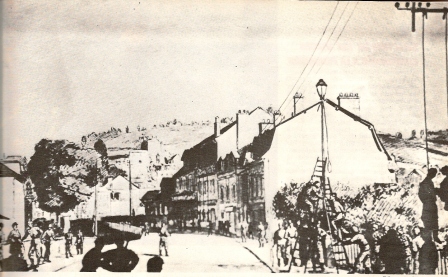
At about four in the afternoon on June 9th the hangings began. The men were lead by groups of ten to a main street of Tulle, where a waiting noose was hanging from each tree, street lamp, and balcony. German soldiers volunteered to be the hangmen of the 99 men killed that afternoon. Other soldiers looked on, seated at the terrace of a café where they drank fine French wine and listened to music on a phonograph.


For some reason, at the end of the day of June 9, 1944, only 99 of the 120 men had been hanged. German soldiers boasted they were used to this kind of killing; they had hanged thousands in Russia. But in France, where the guillotine was used for the last time in 1977 and the death penalty abolished in 1981, hanging was not part of the justice system and its use inflicted on victims a symbolic exclusion from the community.

On the day of the hangings, except for the sound of a phonograph, all was silence. This atmosphere of terror and death made me think of other hangings, those that took place in the Schuylkill and Carbon County jails in 1877. I am referring to the Molly Maguires.


I had always imagined those executions taking place in winter beneath a cold, gray sky heavy with snow. When I opened The Kingdom of Coal by Dennis L. Miller and Richard E. Sharpless, one of my favorite books about the coal region, to search for the date, I discovered those ten men went to the gallows on the first day of summer, June 21, 1877.

In the year and a half that followed, ten more Irishmen were hanged. Though there are still debate and controversy about the activities and the goals of the Molly Maguires, few would dispute the unfairness of the trials that lead to these men’s deaths.

In June rosebushes are heavy with blooms and in Paris, the air has the delicious scent of linden flowers. It is a lovely time of year. Yet it is also a month where history calls us to vigilance as it recalls the destructive powers of hatred and war.

dimanche 31 mai 2015

Anti-Semitism in France: past tragedy, present danger


On the last Sunday in April, a day set aside in France to honor the memory of victims of Nazi concentration camps, President François Hollande chose to address the nation from a site unique in France: the grounds of Konzentrazionslager Natzweiler-Struthof, a Nazi concentration camp located on French soil.

Until this visit, widely reported in French media, I had never heard of this place, a concentration camp complete with gas chamber, surrounded by seventy satellite work camps, most located in what is today Germany. Since 1960, the camp has been preserved as a memorial and includes a museum and the European Center of Resistance Deportees.


When the camp was first created in 1941 by order of Heinrich Himmler, the village of Struthof was located within the boundaries of the German Reich. This Alsatian village was part of France until the signing of the Franco-German Armistice in June 1940, when all of Alsace was annexed to the Reich. At that time, the French language was forbidden and soon Alsatian men were drafted into the Wehrmacht.

Until the Armistice, Strutfhof was a small ski resort with one hotel, where the inhabitants of Strasbourg, a French city on the banks of the Rhine, would go to ski on weekends. Once it became German, a colonel in the Waffen SS became interested in a vein of pink granite in the mountainside. The first deportees arrived to work in the quarries. The granite they extracted was used in some of the monuments built to honor the thousand-year Reich.


Life in the camp, as in all Nazi concentration camps, was deadly cruel. Subsisting on watery soup and a couple of crusts of bread a day, deportees rose at four, spent hours in extreme heat or cold waiting for daily roll call, and then began a twelve-hour shift of hard labor. Beatings were routine, disease rampant, death and hunger, daily companions. In all, 52,000 deportees passed through Natzweiler-Struthof between 1941 and 1945, when the last of the satellite camps were evacuated. Around 20,000 of them died.


Many of the first deportees to work and die at Natzweiler-Struthof were political prisoners or resistant fighters of over thirty different nationalities. There were also common criminals and homosexuals. In its early days, there were few gypsies or Jews.

In 1944, Jews from Hungary and Poland began filling the camp and at least 14,000 of them died. They were not, however, systematically gassed as at Auschwitz. Hard labor, malnutrition and forced marches, once the evacuation of the satellite camps began, were most often the cause of death.

Some also died as victims of scientific experimentation, and it is for that reason that the gas chamber at Struthof was built. German scientists working at the Reich University of Strasbourg used deportees in their experiments on combat gasses.

On November 23, 1944, US troops entered Natzweiler-Struthof, making it the first concentration camp to be liberated by the Allies. The satellite camps across the region continued working and killing almost till the end of the war.

In his speech at the camp, François Hollande reminded French citizens that racism and anti-Semitism are still very much with us and we have a duty to protect those who are its victims.

Today France has a Jewish population of 475,000, less than 1% of the total population, yet 51% of what the French call “racist acts,” some deadly, are directed against Jews. In March 2012, in the schoolyard of a Jewish school in Toulouse, a gunman shot and killed a rabbi, his two small sons and an 8-year-old-girl. In January 2015, during a three-day rampage of terror in Paris that left 17 dead, four shoppers were killed inside a kosher supermarket because they were Jews.


Since those attacks, the French government has put in place a program called “Sentinelle”: 10,000 soldiers joined by 5,000 police officers have been assigned to guarding “sensitive” spots in France. This includes embassies, the headquarters of news organizations, and synagogues.

In my neighborhood there are several synagogues. Since January, I have grown accustomed to seeing soldiers with machine guns in the streets.

All over Europe, anti-Semitism is on the rise. In France, Belgium and Denmark, terrorist attacks have targeted Jews and Jewish institutions. In France, anti-Semitism has also taken other forms which, while not deadly, are nonetheless violent. Jewish children are the victims of name-calling in schools; those wearing what the French call “conspicuous signs” of their religion are insulted in the streets. Within the Jewish community itself, there is a subtle pressure to camouflage one’s faith (an example would be covering a yarmulke with a baseball cap).

In November 2014, French Prime Minister Manuel Valls received the Lord Jakobovits Prize from the Conference of European Rabbis for his efforts to fight against anti-Semitism. Valls emphasizes that the enfranchisement of French Jews, who received citizenship in 1789, is one of the founding principles of the French Republic. He also warns against the danger of conflating anti-Zionism and anti-Semitism, turning criticism of Israel into attacks on the Jewish population of France.


The recent deadly attacks against Jews in France were perpetrated by young men claiming to act in the name of Islam. They were all French citizens, born in France, of parents from Algeria or Mali. They were not representative of France’s Muslim population, estimated to be around 4 million, of which 2 million regularly practice their religion (these approximate figures are based on surveys conducted by the French national institute of demographics; the government does not officially collect religious or ethnic data concerning citizens). Nor were they representative of young Muslims in France today.

Yet France does indeed have a “Muslim problem,” another manifestation of French anti-Semitism if we extend this term to include descendents of Arab as well as of Hebrew peoples. Large segments of France’s Muslim population, in its majority of North African descent, have been relegated to the status of an underclass, bearing the heaviest burden of unemployment and underemployment. French Muslims are often victims of discrimination on the job market. Veiled women are victims of insults in the streets.

All over Europe, anti-Semitism and fear are on the rise. Our best bet is to learn to understand each other and to live together. Otherwise, we’ve got a lot to lose.

To learn more about Natzweiler-Struthof, readers can visit the camp’s site in English:
http://www.struthof.fr/en/home/


dimanche 26 avril 2015

Live entertainment: past, present and the way of the future?


On a rainy April evening in Paris, I went to the theater. I had a free ticket that I’d picked up at work, at the ticket office at my university where students (and teachers) can get discounts and sometimes tickets for free. I didn’t know anything about the play I was going to see. I just felt like going to the theater so I walked in and took a seat.

The lights went down. A man sitting in the front row stood up and stepped onto the stage. He began by speaking in Italian. I felt an uncomfortable rustle around me. The play was called Nous n’irons pas ce soir au Paradis, “This evening we won’t go to Paradise.” So where were we going, we asked ourselves.

In the end, we went to Hell, and to Purgatory, a voyage that transported us outside of time to a place where minutes don’t count, where the worries of daily life fall away, where nothing matters as much what is happening this very instant on the stage:

In front of us stands a man in street clothes. There are no props, no stage décor. There’s simply one man, the actor Serge Maggiani, who speaks to us about another, the Italian poet Dante Alighieri, author of The Divine Comedy.


Sounds like pretty highbrow stuff, doesn’t it? A narrative poem written in the early 14th century where all the characters, except the poet, are dead, some freezing in Hell (yes, the coldest parts are reserved for the worst sinners), others biding their time in Purgatory, and a happy few residing in Paradise (we won’t be going there, we’ve been forewarned).

But the evening is anything but that. Serge Maggiani, our guide, introduces us to Dante and points out that’s the poet’s first name. Right away we’re on a first-name basis with a man who, like us, has known suffering, disappointment and loss in love.


In fact, when Dante begins his journey, it sounds like he’s seriously depressed. He’s lost in a dark forest and with each step sinks deeper into the mire. In real life, he is an enemy of the powerful pope Boniface VIII and has been condemned to permanent exile from his beloved Florence. He has no income, no home, few friends.

He does have ink, pen and paper, however, and though he has been deprived of his birthplace, no one can take his native tongue away. Dante writes in the Italian of Tuscany at a time when no self-respecting writer would use anything but Latin. He lives in his language and makes it his home. Participating in the creation of the Italian language that will one day be spoken all over Italy, he also takes a writer’s sweet revenge when he condemns Pope Boniface to Hell before he’s even dead.

By the end of the evening, we may not have been to Paradise but we’ve met Dante, as real, as close to us as any man alive. We’ve also encountered the poet’s special genius and had a taste of eternity.

That rainy April evening, I experienced a moment of serendipity that no screen could ever give me. What I found with a group of strangers and a single actor on stage I could never find on my computer, my cell phone, my TV or even a giant movie screen. Live theater makes us more alive and this is something we all need.

In Pottsville, the people who have worked so hard to bring back the Majestic Theater understand this. They understand the importance of a community theater that makes live entertainment available at a reasonable price. Recently there have been Robert Thomas Hughes’s “A Miner’s Tale,” and “Triumph and Tragedy” to commemorate the end of the Civil War.

I remember the Majestic Theater when it was a farmer’s market. My mother remembered it from its early days as a movie theater though I don’t know if she ever knew it as a nickelodeon. That’s how the Majestic began when it first opened in 1910, four years before the great fire of 1914, which destroyed the city’s finest theater, the Academy of Music.


Rooting around in the past, I came up with the name of Robert B. Mantell, a well-known actor in his day. In New York and on the road, he played all the great Shakespearean roles and married four times, each of his brides a leading lady who played at his side. In September 1902 he was on stage at the Academy of Music in a popular play of the day, “The Cross and the Dagger.”


The following year, in the same theater, the Pottsville Musical Society put on a production of Gilbert and Sullivan’s “Pirates of Penzance.” In 1913, the year before the Academy burnt down, the Honey Boy Minstrels were on the bill. Led by George Evans, co-author of “In the Good Old Summer Time,” they sang and performed vaudeville acts.

Once the Academy of Music was gone, other theaters took its place. The Hippodrome on E. Market Street brought in vaudeville acts and big bands. The Capitol on N. Centre Street was more palace than theater. It could seat over 2,700, had thirteen dressing rooms for vaudeville stars, and its interior décor was a cross between a Moorish castle and a very ornate Italian church.


Pottsville also had dance halls and in the days of prohibition, speakeasies galore. At the Holly Roof on the top floor of the Hollywood Theater, couples danced to the beat of Paul Whiteman’s orchestra and the Dorsey Brothers of Shenandoah were regulars in town. There were also lots of clubs and bars on Minersville Street.

In the 1930’s and 40’s, Pottsville had so much live entertainment that the city was off limits to soldiers from Indiantown Gap (though this was a rule hard to enforce). A trip to Pottsville was the equivalent of a descent into Dante’s Inferno. In just one visit, a young man could lose his soul, his health, and every penny in his pocket.

It would be easy to say “those were the good old days,” but they weren’t. There was the Great Depression and World War II. To make it through hard times, people got together to dance, sing, go to a show. They had fun and we could have more too if we put our screens aside and exchanged the virtual for the live.

dimanche 29 mars 2015

The world’s biggest “button tin” on display


Do people still have button tins filled with hundreds of buttons, each one different, a world unto itself? Do mothers still take them out of a cupboard or down from a high shelf for their children to sift through on rainy afternoons?

I spent hours of my childhood with the family button tin, trolling the bottom, always coming up with a button I’d never seen before. That button tin was a treasure trove and one of my favorite toys.

Later in life, I forgot about buttons or, let’s say, they became functional objects, a part of everyday life. Buttoning up, unbuttoning, smooth yet by no means simple movements I undertook without giving them a thought.

Since I recently visited the biggest button tin in the world, all that has changed and I’ve returned to my earlier fascination with buttons. In fact, I’ll never look at a button in the same way again.

The “button tin” in question is on view in Paris at the Musée des arts décoratifs, the Museum of Decorative Arts, located in a wing of the Louvre. Continuing until July 19, 2015, “Déboutonner la mode,” “Unbuttoning Fashion,” is all about buttons, 3,000 of them, each one unique, each one a work of art in miniature, all part of a collection of 37,000 buttons acquired by the museum in 2012.

That’s a lot of buttons; it’s also a lot of history.

Buttons are as old as clothing and as far back as the Bronze Age, over three thousand years ago, our ancestors were using buttons to accessorize, but not to button up—they had not yet invented the buttonhole.

In 1250 in France, the first button-makers guild was created at a time when buttons were a luxury item and a token in the game of love. Aristocratic ladies wore tight-fitting gowns that buttoned up the back and had button-on sleeves, practical because they could be changed when dirty, romantic because they could be offered as keepsakes to their beloved knight.

Treated as family heirlooms, fashioned from gold or precious stones, they were passed down in wills and used to pay off debts. Monarchs passed laws against them. Aristocrats were stepping out of line, spending a fortune on buttons, and when they wore them at court, they out-dazzled the king.


The Church also understood the danger of buttons. The deadly sin of lust was associated not only with an intense desire for sex but also for luxury. All that money spent on buttons could lead to eternal damnation, as could their vain display on bodices, breeches or gowns.

In the 17th century, the Amish and the Quakers shared this view, which explains why they preferred clothing with hooks and eyes. Well into the 19th century, buttons were considered inappropriate on funeral garb.


But neither the Church nor the King could stop the rise or the spread of the button, and the French and American revolutions did the rest, transforming the precious buttons of the past into democratic commodities, with the help of the English, the first to mass-produce buttons in the mid-18th century.

In 1789, on both sides of the Atlantic, buttons participated in revolution and democracy. In America, men sported an American eagle or George Washington’s portrait on special buttons created for his inauguration. In France, revolutionaries proudly displayed their political convictions with buttons that were “bleu, blanc, rouge” (blue, white and red).


In those budding democracies, “campaign buttons” remained functional. Men used them to button coats or breeches. Women hardly wore them at all. When they did, however, a button could serve the same role as a brooch. Porcelain buttons were often hand-painted with the portrait of a child. Men’s buttons, on the other hand, took up the issues of the day: a call for an end to slavery, the celebration of the hot-air balloon, or souvenirs of famous monuments or events.

Sometimes a row of buttons could contain a riddle, a message of love or an in-joke for friends. Popular at the time of the French Revolution, this practice of using buttons to communicate continued well into the 20th century, as a woman’s dress from the 1940’s demonstrates: down its front, a row of buttons announces “my sweetheart is a prisoner of war.”

In the 19th century, men’s fashion became more sober and women’s fashion began imitating men’s. The braiding and triple rows of buttons found on military uniforms began appearing on women’s coats.


In general, as the button lost its prominence in men’s fashion, it began showing up everywhere in women’s, on camisoles, bloomers and petticoats, on skirts, dresses, gloves and boots. And once again, it became a marker of social class because only a woman with a lady’s maid could make sure she was properly buttoned up the back.

If the button had a heyday, it was the 20th century. Fashion, art, craftsmanship and mass production all united to turn it into a work of art accessible to everyone, and the number of materials used to produce buttons boggles the mind: glass, plastic, mother-of-pearl, straw, stone, fur, cut steel, papier-mâché, wood, nut and sea shells, copper, leather, even coal and elephant skin, to name just a few.


Also, once women got rid of their corsets, rejecting the hour-glass figure and smelling salts for freedom of movement and form, the button came into its own as a full-fledged fashion accessory. For the French designer Paul Poiret, whose 1920 dresses favored vertical lines, a button’s sole purpose was to bring harmony to the new feminine silhouette.


In the 1930’s, artists such as Salvador Dali made buttons and surrealism inspired fashion, as button-makers reached new heights of creativity. The most stunning example is a 1937 woman’s jacket by Elsa Schiaparelli. In the place of buttons, four painted plastic butterflies alight down its front.


For fashion designer Yves Saint Laurent, buttons were the jewels of his creations. The credo of Coco Chanel was “never a button without a buttonhole.” For both, buttons were as essential to fashion as any of the other materials used.

The 1950’s was the golden age of costume jewelry and the same techniques were often applied to buttons. If any readers have a button tin at home, I’d recommend they take a look inside. They may come across treasures, even objects of value, relics of that time.


All in all, the button may be small but it is not humble. And from now on, each time I touch or see one, I’ll give it the credit it’s due.


dimanche 22 février 2015

“Railside France” brings back memories


Old-timers like to reminisce. I guess I’m an old-timer then, because ever since I visited the headquarters of the French Association of Friends of the Rails (AFAC: Association française des amis des chemins de fer), I’m alive with memories of train travel the way it used to be in the “olden days” of Schuylkill County a half-century ago!

The headquarters of AFAC, an association dedicated to all facets of rail technology, is located in the basement of Gare de l’Est, one of the six major train stations of Paris, serving points in eastern France and Germany.

Beneath the station, you can also find a shopping center, a parking lot, and a metro station where three different lines cross. Somewhere in that underground labyrinth there is a door, behind that door, a hallway and then another door that leads to an old-fashioned wooden staircase. At the top, AFAC opens every Saturday afternoon to those lucky visitors who have found their way.

Once inside, once past the administrative office and the library, where a group of white-haired men deep in discussion ignore the bustle of visitors, we enter “Railside France,” a world in miniature, where model trains travelling at speeds equivalent to 80mph rush through tunnels and around sharp curves, crossing towns, cities, mountains and countryside that replicate the urban and physical geography of France.


The association possesses three platforms, all of which conform in the minutest detail to the standards of the French rail system, right down to the switching equipment and the railway signals. The most popular, built to the HO scale of 1:87 (model train buffs will understand), has an oval circuit with about 150 feet of track where sixteen electric engines can run at the same time. There is even a terminus with ten station platforms and nearby repair and cleaning stations.

The model trains, all replicas of engines and cars that run or once ran on French tracks, pull into stations that could be nowhere else but in France. Anyone who has ever travelled there will recognize the two-story country stations with their red-tiled roofs and stucco façades painted in pastel tones. On the miniature platforms travelers wait for the train, some leaning out over the tracks, others seated on benches, with, on the wall behind them, posters that look like the real thing, as do the station clock and the sign with the station’s name.


High in the miniature Alps, a model train fitted with cog wheels zigzags in and out of mountain tunnels. In Provence, a train traverses a valley between hills with stone villages perched on the slopes.

In honor of the station that is home to the association, originally called Gare de Strasbourg, the capital of Alsace, members have built by hand a miniature main street of an Alsatian town. Naturally, there is also a replica of Gare de l’Est and just like the station above, recently renovated, its miniature underwent a major overhaul in 2014.


Wandering from room to room, from platform to platform, from one miniature corner of France to another, I’m reminded of my first visit to Roadside America in Shartlesville, PA. I can’t remember if it was an outing with the church choir or with the Brownies, but I’ll never forget my fascination and delight with the miniature main streets lined with houses whose windows glowed, making me feel as if miniature families really lived inside.

“Railside France” may not be as grand as Roadside America, “the world’s greatest indoor miniature village,” but it is a fitting tribute to a nation that has built a first-class rail network for both passengers and freight.

Freight trains still cross Schuylkill County, still hauling coal, but in no way can the tonnage compare to the days after World War I when the Saint Clair coal and rail yard was the biggest car and engine repair station in the nation and the biggest coal yard in the world. I still remember the rows and rows of tracks and the huge round house, which I could see from the Mill Creek Bridge when I was a child. After it closed in 1964, I visited it with my father and finally got up close to the monumental building, circling it, looking up at its glass and cement walls, feeling very small.


I also remember the Reading Station on East Norwegian Street, as I imagine many readers do. It was a big wooden structure, brown and tan (in my memories), Victorian in style, with a covered porch facing Railroad Street and the William Penn Hotel.


Sometimes I’d go to the station to wait for my father to come home from a business trip, running to him when he stepped off the train, dressed in the elegant way men dressed in those days: he wore a blocked felt hat and an overcoat over his gabardine suit. Sometimes I’d go there to catch the train myself. My Aunt Mildred often took me to Reading to go shopping and have lunch at the Crystal Restaurant. On rare occasions, we’d travel all the way to Philadelphia to visit the eagle at Wanamaker’s and eat at the automat.

Memories, memories! The Crystal Restaurant, the eagle at Wanamaker’s, the automat, young readers may have no idea of what I’m talking about, but old-timers like me surely do.

They probably also remember the quiet beauty of the train ride between Schuylkill Haven and Hamburg, which followed the path of the Schuylkill Canal through thick forests until it reached the Kernsville Dam. For miles, the train left the noise of highways and cars behind, travelling beneath a canopy of green in summer, through pristine fields of white in wintertime.


I loved that train and I rode it until service between Pottsville and Philadelphia was discontinued around 1980. The train was fast, quiet, relaxing. Too bad it had to come to an end.

Today train travel is making a comeback in the US and there are predictions a high-speed rail network could be in place by 2030.

In France, the first high-speed train, the TGV, joined Paris to Lyon in 1981, cutting travel time in half. Soon afterwards the first miniature TGV showed up at AFAC headquarters, where members are too busy keeping up with the times to feel nostalgic about the past.