dimanche 27 janvier 2019
Prisons and Wild Roses
In the 1980’s, before I moved to France, I taught at a French high school in New York City, le Lycée français de New York. Students were extremely well-behaved, in part because of a rigorous, almost military, system of discipline.
Upon entering the classroom on my first day, I stepped back in near fright. Seeing me, uniformed students jumped to their feet, standing straight, shoulders back, and cried in unison: “Bonjour, Madame.” This was not my first teaching experience, but this had never happened to me before.
In one of my English classes, Nathaniel Hawthorne’s The Scarlet Letter was required reading. I brushed up on Hawthorne and read the novel. Though I found it hard going, I was intrigued by this story of adultery in 17th century Boston.
The Scarlet Letter begins with two powerful symbols: the door of the prison built by the Puritan fathers and a wild rosebush growing off to its side. The narrator points out that all societies require their prison and their cemetery. More subtly, he suggests they need their wild rosebush as well.
During this month of January, I’ve been in prison and had prisons much on my mind. Don’t worry, I haven't been arrested. I was in Philadelphia and while there, I did something I’d been wanting to do for years: I visited Eastern State Penitentiary, the world’s first modern prison, and for anyone who has never been there, it’s well worth the visit.
Eastern State Penitentiary, or ESP as it’s known, is a place of many firsts. When its first prisoner entered in 1829, he discovered a simple cell with running water and central heating, the first institution in the United States to offer these conveniences, long before the President knew such comforts in the White House.
ESP also gave new meaning to the term “penitentiary,” originally reserved for priests responsible for penitents, or for the place where they were confined to reflect on their sins. It was a religious term. In the United States, in the early 1800’s, it became synonymous with a state prison.
Philadelphia is known as the Quaker City and prominent Quakers were among the prison’s founders. For these well-meaning men, prison was for repentance, penitence and punishment, a necessary ingredient on the road to rehabilitation. Prisoners of ESP lived in individual cells, lighted from above, with white-washed walls and wooden floors. They had a bed, table, and work bench. This represented relative comfort in 1829.
But they also lived in solitary confinement for as long as their sentence lasted, never setting eyes on another living soul. When they had to leave their cells, their heads were covered with a sack. There was no collective workspace or recreation. The prisoner was left entirely alone to reflect and repent of his crime. This mode of incarceration gave birth to what became “the Pennsylvania system,” exported throughout the world.
ESP was originally meant for 250 inmates. At the beginning of the 20th century, it housed about 900, requiring doubling up in cells. Long before, the strict solitary confinement imagined by the prison’s founders had come to an end.
In Paris, there is a 19th century prison whose organization was in part inspired by ESP: la Santé, inaugurated in 1867 and operational still today. When it first opened, Napoleon III was Emperor of France, and the chief administrator of Paris was a faithful ally, Baron Georges Eugène Haussmann. His mission was to tear down old Paris and turn the city into a modern capital, which included a state-of-the-art prison.
Haussmann commissioned architect Joseph Vaudremer to build France’s first penitentiary. Its name, la Santé, means “health,” an echo of a 17th century hospice that once occupied its grounds.
Vaudremer designed a prison that adopted not only the Pennsylvania, but also the Auburn system, named after a penitentiary in upstate New York. There, in the 1820’s, prisoners spent their days in a collective workspace and their nights in solitary confinement in narrow cells. Moving between the two, they marched in lockstep and were the first to wear striped uniforms.
In 2014, la Santé was the symbol of the general decay of the French prison system. That year it was closed for renovations. On January 7th, 2019, it reopened its doors to its first 80 inmates (the renovated prison is designed for 800) and then quickly locked them inside.
Each prisoner now has an individual cell that is basically a 90-square-foot studio with a small bathroom and an electric burner for cooking simple meals (many Parisians live in spaces that small, but they’re free to open their front door).
In some cells, however, bunkbeds have been installed. The French system is overcrowded and prison director Christelle Rotach anticipates an occupation rate of 150%.
Eastern State Penitentiary closed in 1970. Though it has been a National Historic Landmark since 1965, the prison was abandoned from 1970 till 1991, when restoration began. Today, ESP is also used as an exhibition space, a venue for special events, such as Bastille Day, and the set for films.
La Santé and ESP are both imposing reminders of a conception of punishment and control dating back to the late 18th century. That is when English philosopher Jeremy Bentham invented the panopticon, a mode of controlling prisoners through their fear of being watched.
For Bentham, the ideal prison (though he also applied his ideas to schools or hospitals), was a circular structure with a watchtower at its center. This became the floorplan of ESP, designed by English-born architect John Haviland, with cellblocks, like the spokes in a wheel, radiating from the central watchtower. From within, hidden from view, a single watchman could observe all inmates though they could never be sure when he was watching them.
Such a system encouraged prisoners to behave as if they were being constantly observed, prompting them to regulate their behavior at all times. This would lead, in Bentham’s words, to “a new mode of obtaining power of mind over mind.”
In Hawthorne’s 17th century Boston, there was only one prison. Today the United States has become a nation of prisons, with the highest incarceration rates in the world. As for prison reform, 21st century reformers seem no closer to knowing how to rehabilitate those behind bars than were those Philadelphia Quakers 200 years ago.
In one area, however, great progress has been made. Inside and outside of prison, video and virtual surveillance are everywhere, giving those doing the observing “power of mind over mind.”
These are hard time for the wild rosebush growing outside the prison door.
lundi 31 décembre 2018
In Margon, France, a “Yellow-vest Christmas” and “Yellow-vest New Year”
A wooded hillside. At its summit sits a compact stone church, its bell tower a beacon since the 11th century. Below the church, a road spirals around the hill; a row of low stone houses hugs the edge.
At the foot of the hill, only a few hundred feet from the church and this postcard image of rural France, semi-trailer trucks and cars block a traffic circle bordered by a commercial zone of parking lots and discount stores.
This is where the “Yellow Vests” (they’ve named themselves after the yellow safety vests all French drivers must carry in their glove compartments) have set up camp, on a grassy slope between the church and the highway.
This is where some of them are celebrating Christmas and ringing in the New Year: three tents, a meeting space, a canteen and a “backroom” reserved for cots and food supplies. The place is Margon, a village in le Perche, near my country home in lower Normandy.
Margon used to be an isolated village perched on a hillside. Today it is the far end of a sort of strip-mall, with, at its heart, Centre Leclerc, France’s answer to Walmart. At the other end is Nogent-le-Rotrou, a town of 10 thousand inhabitants dating back to Gallo-Roman times, with high unemployment, an aging population, and lower than average incomes.
The day I visit the Yellow Vest camp, rain thrashes against the tents and the sky is dark, but the Yellow Vests are in high spirits, determined to stick it out on this muddy patch of earth till their demands for social justice are met.
Who are they? Why are they celebrating the holidays here? What do they want?
They want to be heard. They are ready to talk, to tell their stories, if necessary, to the world.
Jacques Roussel, 67, tried to reach out to President Macron, responding to his call to turn France into a start-up nation. Jacques began working in a factory when he was 14 and lives today on a pension of less than $1,000 a month. Looker younger than his age, obviously in good shape, he is a fervent cyclist and his idea for a start-up is to create a professional cycling school for girls and women in this region of hills and valleys, the perfect terrain for the sport. As of today, no such school exists in France.
He wrote to President Macron and his wife Brigitte. He got no answer. Now he is ready to go international. At a time when US-French relations are at a low point, he is looking for an American partner who would like to invest in his start-up and contribute to a positive form of cooperation between the two nations.
Of course, that’s not why Jacques is with the Yellow Vests and he wasn’t expecting to meet an American in Margon, but he believes start-ups should be for everyone and can’t understand why his government ignores people like him.
The rain is getting worse. We duck inside the canteen. Valérie, aka Mamy, graciously offers me a hot chocolate. She is here to take care of the canteen, receive the many donations dropped off at the site and make sure the Yellow Vests have hot drinks and food.
She comes daily because she and her husband, a self-employed painter, can no longer make ends meet. Usually she stays at home, takes care of the children, and does her husband’s paperwork. Watching over their finances, she fears they’ll soon not have enough to survive. She first put on a yellow vest out of frustration. Now Valérie keeps coming back because she has discovered a community of friendship and solidarity.
Sylvie agrees. She and her husband lost their business in a court-ordered liquidation. She is proud to have a daughter who attends university but, as in Valérie’s case, money is tight. The more we’re taxed, the poorer everyone becomes, she tells me. And then, she’s fed up with seeing people over 60 rooting in dumpsters because they don’t have enough to eat. That’s why she keeps coming back, for the people who’ve worked all their lives and can’t even pay the grocery bills.
Though he’s only 30, Nicolas too feels for the retired. He can’t understand why President Macron, while giving tax breaks to the rich, has increased the tax burden on retirees. That’s why, in late November, he left his village and joined the Yellow Vests. He has stayed and become the camp’s night watchman. In the early morning, he greets motorists with what may be their first smile of the day.
Jean-Marc Cipoire stops by daily to document events for Le Perche Web-TV, a site he created to give greater visibility to the region. He is on disability and lives on about $700 a month. He never goes to a restaurant, but nothing could keep him away from the 24 Hours of Le Mans, where he follows racing events for his web-TV. Spending as little as possible, he and his companion Sylvie pitch a tent and cook their food over a fire.
Sylvie has never been to Paris, less than 100 miles away. Nor has Magaly, 63, who, like Jacques Roussel, began working at14. She worked in a local auto parts plant, but somewhere along the line there was an accident, disability. Today she lives on about $600 a month. She owns a house, but the roof is about to collapse. She lives with her brother. He once worked as a locksmith but ended up in the streets of Paris. Magaly has taken him in.
Magaly’s dog Doudou, a black cocker-spaniel mix, is the site’s mascot. And like Nicolas, Magaly plans to stay as long as it takes, ready to start 2019 at the edge of the highway. Among all Yellow Vests to whom I spoke, she is the only one to express hostility to immigrants. Otherwise, the message is “everyone welcome.” Immigrants, the unemployed, workers, the retired, people of all races and religions, we’re in this together.
Leaving the camp, I feel buoyed up by the “Yellow Vest spirit,” warm acceptance of outsiders and generosity towards all, the “Christmas spirit,” in other words.
Recent events in Paris have made it all too clear that some Yellow Vests are ready to resort to destructive violence to get their message across. But the movement is about much more than anger or hatred. In places like Margon, people are creating spaces where they can speak up and be heard.
To quote one of the Yellow Vests, Jean-Michaël Verrier, a young landscape gardener, “Macron has accomplished at least one thing: he’s got us all talking to each other,” an excellent way to begin 2019.
dimanche 25 novembre 2018
November, month of death, war, and hopes for peace
In November, in this small corner of France called “le Perche,” the last leaves are falling and even the sky seems tired of holding itself up. A thick gray pall covers the earth. The month started this way, with what the French call, “un vrai temps de premier novembre,” appropriate weather for All Saints Day, November 1st, rain, low clouds and damp.
Two weeks later, as I sit at my desk, rain continues to fall. Good for the earth, say the farmers, hoping for rain right through to Christmas for their summer-parched fields. Folk wisdom claims that’s what’s best for next year’s crops.
November is also the month when the thoughts of the French turn to death. Americans remember their dead on Memorial Day, originally a day to commemorate those fallen in battle. Today both the graves of veterans and family members are decorated on the last Monday in May. The French travel to cemeteries on November 1st, their “Memorial Day,” and place big pots of yellow, orange or purple chrysanthemums on family tombs.
In the United States, on November 11th, the country honors its veterans. When I was a child, we called this date “Armistice Day,” to mark the end of the first World War. In France, “le 11 novembre” could not possibly refer to anything else. That war’s major battles were fought on French soil, blasting entire cities and villages from the face of the earth. The French nation lost one third of its economic wealth, and nearly 7.5 million acres of farmland were declared unfit for crops. At the war’s end, fields were littered with unexploded shells alongside corpses of horses and men.
Ten million died in the conflict, 20 million were injured. Many soldiers were disfigured or lost limbs, unable to return to “normal life” after the war. Many bore psychological wounds that dogged them for life. At the war’s start, the French government drafted more than 7 million men; between 1.4 and 1.5 million of them died. Civilian deaths throughout Europe were between 5 and 10 million, which includes those who died in the Russian Revolution and the Armenian genocide of 1915.
These mortality figures boggle the mind. That is why Ernest Hemingway, in A Farewell to Arms, his great anti-war novel about World War I, could write, with irony, “At the start of the winter came the permanent rain and with the rain came the cholera. But it was checked and in the end only seven thousand died of it in the army.”
And the list of horrifying figures goes on: 3 million widows, 6 million orphans, many abandoned, some exploited, as was the case of British orphans shipped to Canada as cheap farm labor after the war.
This year November 11th marked the centenary of the end of World War I. It was a day of solemn celebrations in Paris. After marching up the Champs Elysées, 72 world leaders gathered beneath the Arc de Triomphe, where an eternal flame burns in honor of France’s Unknown Soldiers.
At 11 AM, the exact hour of the signing of the Armistice 100 years before, President Emmanuel Macron recalled the terrible sacrifices made by French soldiers for the nation. He reminded French citizens of their patriotic duty to honor those men and the universal values for which they fought: liberté, égalité, fraternité.
On this same day opened the Paris Peace Forum, an international conference whose goal is to seek multilateral solutions to war and crises throughout the world. German Chancellor Angela Merkel gave the opening speech, followed by those of President Macron and UN Secretary Antonio Guterres. President Donald Trump was conspicuously absent.
Back in le Perche, I commemorated the centenary in a more intimate way. In the town of Rémalard, equipped with a fine theater, I went to see a play based on a French young-adult novel, l’Horizon bleu by Dorothée Piatek, with illustrations by Yann Hamonic. It is the story of Pierre and Elisabeth, both elementary school teachers in a small village in northern France at the beginning of the war. On August 1, 1914, when the order for a general mobilization is given, Pierre is drafted and must leave home. This marks the beginning of a separation that will last more than four years.
Two actors, Martine Salmon and Karim Feddal, have deftly adapted the story of Elisabeth and Pierre for the stage, choosing excerpts from their letters, acting out significant events with powerful simplicity. On one side of the stage, there is a teacher’s desk, on the other, a wooden school bench. In between, a screen where illustrations from the book accompany the actors’ words and actions. There is also music, not of the period but of today, a rhythmic background uniting 1918 and 2018.
Thanks to Martine and Karim, Elisabeth and Pierre are close to us. We share their pain and despair, their courage and strength. We experience the war, not as abstraction, but as real events in the lives of people like us: the death and filth of the trenches, the loneliness, the necessity of carrying on to stay alive.
Every village in France, no matter how small, has a memorial to local soldiers who died in World War I. No family remained untouched. That was 100 years ago.
Today, soldiers and civilians continue to die in terrible wars, wars of proxy, such as the one going on in Yemen, where Saudi Arabia attempts to limit Iranian influence in the Middle East. Orphans wander in refugee camps, cholera spreads among the general population, civilian casualties are high. A documentary where Yemenite children speak to each other about this war provides a series of poignant, at times unbearable, testimonies. I provide the link to the French version, but another with English subtitles can be found on-line: Les enfants et la guerre (Kids and War), directed by Khadija Al-Salami https://www.youtube.com/watch?v=iRb01Y6WmZg
In President Macron’s November 11th speech to the French nation and the world, he encouraged patriotism and condemned nationalism as the “betrayal” of patriotic values.
President Trump considers himself a “nationalist.”
France’s General de Gaulle, a model of integrity, had this to say on the subject: “Le patriotisme, c’est aimer son pays. Le nationalisme, c’est détester celui des autres.” Patriotism means loving your country. Nationalism means hating other people’s.
Patriot or nationalist? In this dreary, dying month of November, we should give the matter some thought.
lundi 29 octobre 2018
Halloween Horrors and Local Ghosts
Since I moved to my country house in le Perche, I’ve often wondered about ghosts. I’ve even asked myself if my house is haunted by spirits of the past. In the United States, except for places like Boston or Philadelphia, few homes are centuries old. Here many are—mine is—and that means a lot of living—and dying—within these walls.
Washington Irving, the American author who gave to his country some of its best-loved ghost stories— “The Legend of Sleepy Hollow,” “Rip Van Winkle”—had a bittersweet theory about American ghosts. Contrary to their European counterparts, they didn’t get to do a lot of haunting. On Halloween, they were left twiddling their thumbs, roaming aimlessly around cemeteries and the homes they once inhabited. Their descendants had responded to the call “go West, young man,” leaving no one behind to haunt.
According to Irving, ghosts remain attached to their roots, they are not infected with Wanderlust. They’d love to move back in with the family, but what happens when they have no idea of where the family has gone?
In the 20th century, the movie industry gleefully found the answer: ghosts, vampires, zombies, monsters or evil creatures from outer space, thanks to the wonders of technology, can—and want—to go just about anywhere. In the 1956 movie “Invasion of the Body Snatchers,” alien spores fall from the sky with the same randomness as drops of rain. They could turn into you, me, anybody, reproduced identically, full-grown, in a pod found floating in the family pool.
I’ll admit, I’m not a big fan of horror movies. I’ve always been too impressionable, though I may have been turned off to them for life because of an experience in the former Hollywood Theatre of Pottsville. It was Halloween 1968 and what could be better than a horror double-feature? My friend Nancy Higgins-Schlitzer and I bought tickets and popcorn and then climbed to seats in the balcony.
The first film was about a mad scientist making some kind of green goo in his laboratory. It was silly, but we had fun laughing and pretending to be scared.
Then there was a brief intermission and the second film came on. It was “The Night of the Living Dead.” Today considered one of the best horror movies of all time, in October1968, the very month of its release, this low-budget zombie film paralyzed us with fear. As corpses wander down small-town streets, a powerless TV anchorman announces, “These ghouls are eating flesh.” We wanted to run, escape from these very ordinary-looking zombies, but we were too afraid.
Still to this day I wonder if anyone working at the Hollywood had watched this film before it was projected for that special Halloween show. It was not a film for children and that’s what most of us were. Although I couldn’t have explained it then, I knew “The Night of the Living Dead” was about more than horror and I knew we were not safe. Nancy and I left the theater stunned. We’d been looking for fun and some scares. We got more than we’d bargained for.
For decades now, horror films have been so bloody, at times so sadistic, that I shy away from them. Vampire films abound, but none have ever equaled the two all-time greatest, the 1922 German “Nosferatu” and Hollywood’s 1931 “Dracula” with Bela Lugosi. Egged on by my sister, I watched “Blair Witch Project,” but somehow its frightening charms were lost on me.
The French also have their horror industry, ranging from what I might call “sexy gore,” such as in the 2008 film “Martyrs,” which reaches new heights in torturing women on screen, or the 2006 film “Them,” where horror is subtly created in a haunted house in Romania, bought by a young Franco-Romanian couple. The French horror hits of 2018 are “Ghostland,” directed by Pascal Laugier, who also made “Martyrs,” and “La nuit a dévoré le monde” (The night has eaten up the world), another zombie movie in the spirit of “The Night of the Living Dead.”
But what about good old-fashioned ghosts, the kind who rattle chains or roam hallways at night? Is anybody still interested in them? Are they still around?
I am not sure of the answer to the last question, but I do know lots of people are still interested in ghosts. Doing research for this article, I came across “Ghost Hunters Inc., True Spirit Seekers,” with headquarters in Berks County.
The organization’s investigators have already looked into the mysterious ghost that haunts the lonely road over Gordon Mountain, joining Heckscherville to Gordon. I remember it from my high school days. There were many tales about cars breaking down on the mountaintop, of a ghostly young woman, and even of long scratches on car doors and fenders, desperate attempts by someone, something, to get inside.
As for my own home, I have decided it is inhabited by friendly spirits, happy to have me here, happy with the care I’ve lavished on a cottage about to collapse, that has been built back up again.
But not all in le Perche are as lucky, and I’m not surprised. This misty region of hills and vales is a perfect habitat for ghosts, and as the same families have been around for hundreds of years, ghosts naturally feel at home.
On the site actu.fr, devoted to local news from all around France, I’ve discovered some documented ghosts nearby. In 2009, a family with three children bought a Percheron barn, already partially converted to a home. They turned the loft into a bedroom for their children and happily settled in.
Yet, from the start, something was not right. At night, the parents would hurry upstairs to chase their children back to bed only to find them fast asleep. Returning to the living room, the ruckus would start all over again. Running, muffled cries, marbles dropped to the floor. Believing in mischief, they crept back upstairs, but found their children sleeping snugly in their beds.
Things went from bad to worse. Obviously, something, someone, wanted the husband out of the house so he, it, could have the wife to himself. The family called in some paranormal investigators, but, at latest report, all family members and ghosts are still there.
On that unresolved note, I’ll wish my readers a ghostly but happy Halloween.
dimanche 30 septembre 2018
Where Do You Come From?
Americans are proud of where they come from and proud of their pasts. For many Americans, this means a story of upheaval and uprooting, the move from one continent to another, change of language and customs, and the pain of rejection by those who consider themselves the “real” Americans.
Today we celebrate double identities such as “Polish-American” or “Italian-American,” but there was a time in the Pennsylvania anthracite region when such identities were a heavy burden to bear. There was even a time when “real” Americans were ready to shoot immigrant workers in the back if they tried to exercise their rights to free speech and assembly as they struggled for decent working conditions and lives.
On September 10, 1897, as many in the coal region know, such a shooting took place. It happened right across the Schuylkill County line, in Lattimer, a “coal patch” in Luzerne County, situated near a mine owned by Calvin Pardee of Hazleton. At that time, the UMWA was working to organize immigrant miners, many who did not speak English. On September 10th, striking miners at nearby Harwood mine marched towards Lattimer, hoping to convince their fellow miners to lay down their tools and walk off the job.
Striking miners were protesting working conditions and poor pay. They were also rebelling against coercion to shop in company stores where necessities were sold at highly inflated prices. The day of the march about 400 unarmed men, many Polish and Slovak, along with Italians, Lithuanians and Germans, rallied around the American flag as they headed down a road leading to Lattimer mine.
Waiting for them was Luzerne County Sheriff James Martin and a posse of 86 deputies, called in by mine owners because their private Coal & Iron police was not enough. Martin ordered the strikers, on public and not on private land, to halt and disperse. When they continued marching, the deputies opened fire. When strikers tried to flee, most were shot in the back, some multiple times. That day, 19 men died and many more were wounded.
At the time, what has come to be known as “the Lattimer massacre” provoked mixed reactions in the press. The Philadelphia Public Ledger took the side of mine owners and the police, declaring those engaged in “riotous assembly” were dutybound to obey the demands of the sheriff and disperse. The Philadelphia Inquirer at first sided with the owners and the sheriff, but later referred to the shooting as “human slaughter.”
In the anthracite region, The Wilkes Barre Times stood firmly with the owners. The Hazleton Daily Standard deplored that mine owners had not met the men “half-way.”
In February 1898, Sheriff Martin and his deputies were put on trial for the murder of the 19 strikers killed during the march. On March 9th of the same year, they were found “not guilty.”
After the massacre, membership in the UMWA increased exponentially in the anthracite region, but for miners, it was business as usual as they returned underground to 10-hours shifts in total darkness.
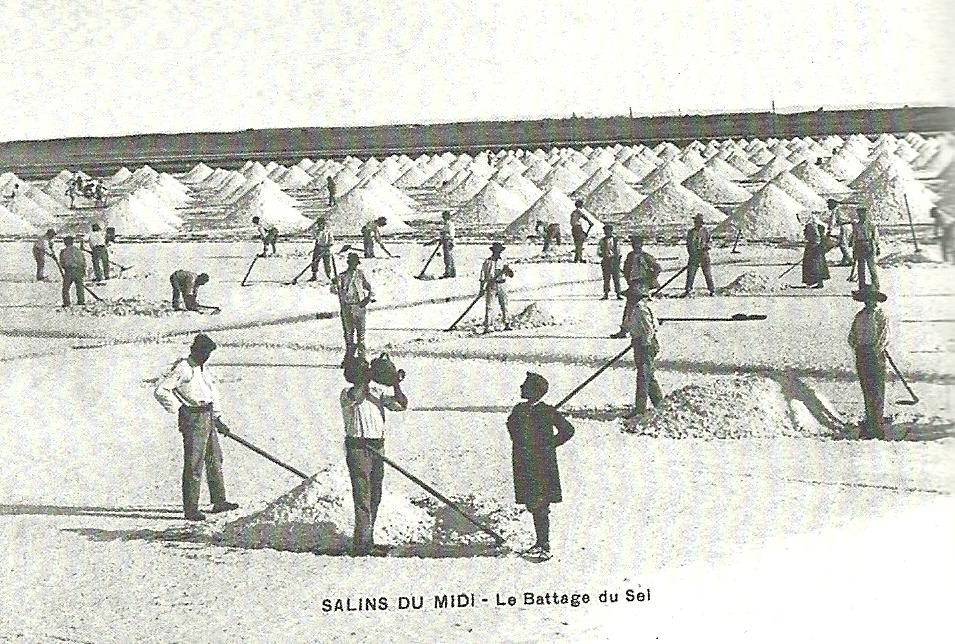
During this same decade, labor and ethnic unrest were spreading in France. Though the French had earned the right to strike in 1864 and trade unions became legal in 1884, many workers continued to organize along regional lines. Such was the case of seasonal workers who harvested salt in the salt marshes of southern France around the Mediterranean port of Aigues-mortes (which translates as “dead waters”).
For many centuries, the production of salt was considered a privilege of the inhabitants of Aigues-mortes, who were also exempt from the “gabelle,” the salt tax paid by other French subjects to the king. By the early 19th century, wealthy local businessmen were buying and privatizing the salt marshes. By the end of the century, many small companies became one in a joint-stock corporation known as the Compagnie des Salins du Midi. At the same time, the demand for seasonal workers increased.
Anthracite mining in the 1890’s was characterized by damp darkness broken by the faint glimmer of a miner’s oil-wick lamp. Salt production in salt marshes was a world of blinding white and no escape from the heat. At that time, in both the United States and France, a great economic depression was going on.
As in the coal mines, salt workers were paid by weight and they worked in teams. In an industry totally dependent on manual labor, they harvested the salt and then transported it in wheelbarrows to warehouses where the salt was weighed.
Seasonal and migrant workers descended from the Cevennes Mountains of southern France. Many also arrived from the Piedmont region of Italy. And then there were the “trimards,” unemployed hobos who risked prison at a time when the life of a wandering man was illegal in France. All worked and lived together, isolated in the middle of the salt marshes in makeshift barracks. The company assigned them to teams, separating nationalities and regions, imposing quotas difficult to meet, and thus creating conflict.
On August 17, 1893, Italian workers became angry, claiming the trimards on their team were not working hard enough. A fight broke out and a trimard was stabbed. Fellow vagabonds rushed towards the town of Aigues-mortes and told the local population that the Italians were attacking the French. Appealing to national pride at a time when anti-foreign sentiment was running high, the trimards stirred up a mob that headed to the salt marshes, convinced French workers were in danger.
Though the gendarmes, the French national police, tried to protect the Italians, 8 men, all Italians, were killed that day and many more were injured as members of a mob armed with clubs and knives fought, so they believed, to protect French honor. Sixteen of them, along with one Italian, were brought to trial for what became known as “le massacre des Italiens.” All were acquitted in an atmosphere marked by strong anti-foreign sentiment.
Earlier this month President Trump announced that the number of refugees that can settle in the US in 2019 will be reduced to 30,000, the lowest number since the refugee program was created in 1980. Specialists of international migration fear such a decision will weaken American moral authority and leadership abroad.
As in the 1890’s, be it in the US or in France, anti-foreign sentiment is once again on the rise. To arrive at a balanced opinion on refugee and immigration quotas, it might be useful to ask ourselves where we come from.
dimanche 26 août 2018
Easy days of summer 2018 turn into memories
Tomorrow all over Schuylkill County students will be returning to school; in France, they still have one more precious week of vacation. Autumn is around the corner and summer is already the stuff of memory.
The French will savor the summer of 2018 for months, even years, to come. For the first time in 20 years, France won the FIFA World Cup, an international soccer championship that takes place once every four years. This is France’s second victory since the competition began in 1930. On the night of July 15th, fans went wild, pouring into the streets to celebrate the victory. There could have been no better way to wrap up the holiday weekend that began with Bastille Day, France’s “Independence Day,” on July 14th.
Next came the Tour de France, which France did not win—the victory went to Geraint Thomas, a Welshman representing Great Britain, but the best young cyclist award went to a Frenchman and the 1st and 2nd place climbers were also French. Perhaps next year will bring victory, as the 2018 tour promises a bright future for France.
But the Tour de France is more than a bicycle race. True to its name, it provides a tour of France: north, south, east and west, from high mountain passes in the Alps and Pyrenees Mountains, from the Breton coast to the Mediterranean Sea, through remote villages and small towns a lot like Pottsville, where everyone turns out to cheer the cyclists on. It’s one of the best ways to get to know the country, a true pleasure to watch—live or on TV. France in all its beauty and variety unfurls before your very eyes while world-class cyclists whiz across the screen towards the finish line, a race down the Champs Elysées in Paris.
This year I saw the cyclists in Nogent le Rotrou, a town near my village, where I go to catch the train to Paris. The Tour’s arrival in town was posted everywhere, but somehow I managed to ignore it and showed up to catch a train just as the cyclists were passing through. All the main roads were blocked, there was no access to the station. I got involved in my own race against the clock, trying to find a place to park my car not too many miles from the station. When I finally did, I grabbed my suitcase and ran, along the same route as the cyclists and the crowd cheered me on, assuring me I’d not miss my train. I was part of the pack, the “peloton,” earning kudos for my speed on foot, just like the cyclists on their bikes.
In France and much of Europe, this summer will also be remembered for “la canicule,” an exceptional heatwave that broke records in Spain, Sweden and Portugal and brought drought and water shortages to much of France. In Pennsylvania, summer has been a steam bath; in France, we’ve roasted in a hot air oven, an unusual phenomenon in my village in usually wet, damp Normandy.
Summer is a time of fairs and festivals. France is known for its theater festival in Avignon and this year, Tiago, a 10-year-old friend of mine, bursting with talent and energy, was on stage for the opening play, a tragedy by the Roman author Seneca. It was staged in the majestic courtyard of what was once the Pope’s Palace during the 14th century, when 7 popes reigned over Christendom from the French city of Avignon.
There were also jazz, piano, opera, rock and folk festivals, and every village celebrated itself at least once, with a flea market, fireworks, a communal cookout and a “bal populaire,” a dance where young and old dance together to polkas, waltzes, tangos, disco and rock.
On my own personal list of most memorable summer experiences, I rate highest my first “Comices agricoles,” a regional agricultural fair, similar to a 4-H county fair. Encouraged in the 19th century as a means to promote and reward progress and hard work in the agricultural community, the most famous of all belongs to fiction. During the heyday of comices agricoles in the mid-19th century, Gustave Flaubert included such a fair in his novel Madame Bovary, the story of a woman who fiercely believes life must conform to the plot of a romance novel.
His comices is the backdrop for a love scene and that’s what gives it all is satirical spice. While cattle low, pigs grunt, geese squawk and roosters crow, in an upper room of city hall, Rodolphe Boulanger, a member of the French gentry, wealthy and blasé, pays court to Emma Bovary, a sentimental woman married to a mediocre man, hungry for “la grande passion.”
Emma has read lots of tales of romance but has never had a lover. Rodolphe, an experienced seducer, has had many. Innocent in her beauty and ways, Emma represents a minor challenge, but even before he conquers her, Rodolphe frets about how to get her out of his life.
As he whispers words of love, outside the master of ceremonies awards prizes for the best hog, the best ram and the best fertilizer. It is a cruelly comic scene, where Flaubert mocks both romantic love and the pretensions of local officials, decked out in uniforms and medals for the big day.
My comices agricoles was much simpler. I admired the handsome Percheron horses and many races of fine bulls and cows, I bought goat’s cheese and honey though I did not partake of the banquet whose main course was a steer roasted in a pit over open flames. I also studied agricultural implements of the past and the latest equipment of the day. The sun was blazing, the sky blue, and summer at its peak.
To wrap up the summer, I attended my first dressage and jumping competition at the French National Stables, le Haras du Pin, about 40 miles from my village, at the heart of France’s horse country. I continue riding, I am learning the basics of the art of dressage, precision movement on horseback. Watching some of the best international riders, my passion for the sport has grown even stronger.
Today is the last day of summer dreaming. Tomorrow school begins and these easy days become memories to cherish till summer rolls around again next year.
dimanche 29 juillet 2018
Identity Problems (2): Bread and Water
This month’s article picks up where last month’s left off. I am alone in Tbilisi, Georgia, without money or passport, wondering how I’ll survive…
Puri, tsqali, bread and water. That’s what I had to eat, delicious Georgian bread baked in an oven that looks like a well. My first day in the city, I saw, literally, a hole in a wall. I went up to it and looked inside. I saw a woman bending over what appeared to be a well. When she stood up, she had a loaf of flatbread in her hands. Seeing me, very naturally, she came to the hole in the wall, the “entrance” to her bakery, and handed it to me. I gave her a five-lari bill. She handed me back a lot of change.
That’s how Georgian bread is made, in a well where, in the place of water, very hot embers burn. On the inner walls, the baker slaps strips of dough. After five minutes, with a metal spatula, she peels off a loaf of bread.
As for water, Georgia is known for its mountain springs. Though once considered prison punishment food, a piece of warm “puri,” a glass of Georgian mountain tsqali,” bread and water, become a simple, noble meal. For me, it was my “daily bread.”
After another search of my apartment, realizing I’d really lost everything, I cancelled my credit card and called a friend in France. He told me he was immediately heading to Western Union to send me some funds.
Money problems taken care of, I moved on to the next challenge: how to get a new passport. I’d travelled to Georgia as a French national though, I’ll admit, I don’t feel very “French.” I called the French consulate and was put through to the vice-consul. She told me the procedure to follow to apply for a new one. I’d need passport photos, a statement from the Georgian police declaring the loss, and most important, 96 euros. Without the money, there’d be no new passport.
When I explained I was waiting for a Western Union transfer, she advised me to go to an agency on Rustaveli Avenue, the “Fifth Avenue” of Tbilisi. There, she assured me, I could get money without a passport. I’d just have to mention the French Consulate had sent me.
Lucky for me the bus in Tbilisi costs 20 cents, and a ticket includes transfers. I took one bus, then another. New streets, new neighborhoods were rushing before my eyes. I saw a big fountain with a statue, Shota Rustaveli, Georgia’s national poet. The vice-consul had told me the bank was nearby. I got off at the next stop.
Inside the bank, I went to the Western Union counter. I explained what I’d been told at the French Consulate. The teller left me alone. When she returned, she said, “No money without a passport.”
I protested, asked her to call the consulate, and demanded to see the manager.
All my requests were granted, but by the time the call was made, the vice-consul had left for the weekend, and her assistant was adamant: without money, no passport, and getting the money was my problem, not hers.
The bank manager, speaking perfect English, also came to talk to me. She told me she’d have to phone headquarters; she could not decide on her own. I was invited to wait; I waited for almost four hours. By that time, the manager had gone home, a new shift of tellers had come on. One was on the phone. She looked in my direction. When she hung up, she approached me and said:
No passport, no money.
That was the final answer. It was 7:30 on a Friday evening. I had less than five dollars. The weekend was about to begin. I felt very alone.
Returning home by metro, I realized my stop was next to a police station. I walked in to make my declaration. I tried to explain in English, in French, in a few garbled words in Russian. The police got the gist; they found me someone who could speak English. She told me I was in the wrong place.
I had to go to another station. I was told to wait; I’d be taken there in a patrol car. When it pulled up, I got in. A second later, we were travelling top speed, weaving in and out of traffic, running red lights—just like in a high-speed chase in the movies, and, you know what? It was a thrill.
A few hours later, I had my statement. I’d told my tale to an official translator who translated my words from French into Georgian. The document was typed, stamped and handed over to me, and I was very favorably impressed with Tbilisi’s finest.
But I still had no money. When I got back to the apartment, I tried to call my friend in France to give him an update. Except my phone did not work. I’d gone over budget; my provider had cut my service. Now I was cut off from the outside world.
It was almost midnight. I decided to go to bed. Like Scarlet O’Hara, I said to myself, “Tomorrow is another day.”
When morning came, I got up and looked out at blue sky. I breakfasted on bread and water. I counted my remaining coins. Enough for transport, more bread and water. I got dressed, headed out.
I’d come to Tbilisi to explore the city and that is what I was going to do. I climbed to the church of Mama Davidi (mama = papa in Georgian), who brought Christianity to Tbilisi in the 6th century; I visited the remains of a Zoroastrian fire temple; I wandered through streets where, in the 19th century, Russians built elegant summer palaces. I saw the opera, the city’s museums, and new glass-and-chrome shopping centers. I also got lost in the labyrinth of the city’s central market, above and underground, around the main train station. I’ve been to bazars in Istanbul and Jerusalem, but never have I visited a market as all-encompassing as this one: it contained the world.
The day of walking exhausted me. That evening, it was bread and water again. Then I was tired and fell asleep.
The next morning depression got the upper hand: I was alone, with no money, no phone. It was 6 AM; another day of bread and water was about to begin. I looked around the apartment. It was a mess. I decided to clean the place.
I started with the bed, removing the quilt. When I grabbed a corner, I felt something solid. I thrust my hand inside the quilt cover, as I thought I’d done the first day. When I pulled it out, I had my passport, my money and my bank card in hand.
Feeling faint, I had to sit down. All along, my identity and money had been nestling comfortably in my bed.
Later that morning, I went to a Western Union agency open on Sundays. I had my passport, now I could get the money, except that I’d declared my passport lost to the police. If I handed it over to a teller, would she have me arrested on the spot? Once again, my throat went dry. Behind her bullet-proof window, she looked at my passport and then made a phone call. I broke out in a sweat. An identity-check. A stolen passport. Jail.
But she returned my passport and handed me the money. I walked outside and took a deep breath. I was free and once again “me.”
In a Turkish restaurant, where I had my first real meal in Tbilisi, I mulled over what had just happened: a nightmare of my own creating, where I’d come as close to down and out as I’ve ever been.
I think it may have been the French passport, the problem of no longer knowing who I am or where I belong. Many dual nationals would understand.
I have long since returned to France, but my identity troubles have not ended. Today I hover somewhere over the Atlantic, halfway between the United States and France.
Inscription à :
Articles (Atom)